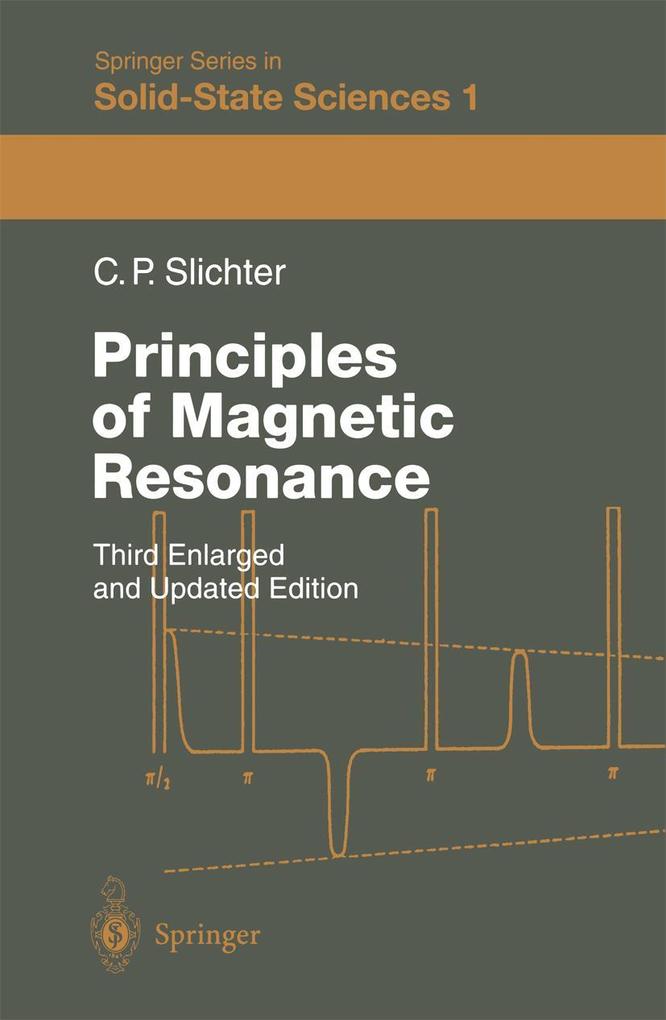
Magnetic resonance is a powerful experimental method for investigating the properties of condensed matter at the atomic or molecular level. This text is intended for graduate students in physics, chemistry, materials science, biology, medicine, or engineering preparing to work in nuclear magnetic resonance (including magnetic resonance imaging) or electron spin resonance, but the topics chosen are highly relevant for those working with lasers or studying relaxation or rate phenomena by other methods. The text assumes the reader has taken a standard graduate level quantum mechanics course in physics or chemistry, and parts of the text may be used to teach such courses. The text goes into details with the aim of preparing students to read the literature of magnetic resonance, but it is targeted at the properly prepared beginner rather than the expert.
The text treats the basic principles of magnetic resonance, of steady-state and pulse methods, the theory of the width, shape, and position of spectral absorption lines, and the theory of relaxation times. It introduces the density matrix, and helps the student become familiar with its use. The third edition adds new material to many parts, plus new sections on one- and two-dimensional Fourier transform methods, multiple quantum coherence, and magnetic resonance imaging.
From the reviews: ". . . one of the best expositions of the quantum theory of resonance in existence. It has my highest recommendation for use as a textbook." Journal of the Optical Society of America "The clarity and style in which the book is written reveals Slichter's research expertise and talent as an excellent teacher and expositor. . ." Physics Today
The first edition of this book was written in 1961 when I was Morris Loeb Lecturer in Physics at Harvard. In the preface I wrote: "The problem faced by a beginner today is enormous. If he attempts to read a current article, he often finds that the first paragraph refers to an earlier paper on which the whole article is based, and with which the author naturally assumes familiarity. That reference in turn is based on another, so the hapless student finds himself in a seemingly endless retreat. I have felt that graduate students or others beginning research in magnetic resonance needed a book which really went into the details of calculations, yet was aimed at the beginner rather than the expert. " The original goal was to treat only those topics that are essential to an understanding of the literature. Thus the goal was to be selective rather than comprehensive. With the passage of time, important new concepts were becoming so all-pervasive that I felt the need to add them. That led to the second edition, which Dr. Lotsch, Physics Editor of Springer-Verlag, encouraged me to write and which helped launch the Springer Series in Solid-State Sciences. Now, ten years later, that book (and its 1980 revised printing) is no longer available. Meanwhile, workers in magnetic resonance have continued to develop startling new insights.
Inhaltsverzeichnis
1. Elements of Resonance. - 2 Basic Theory. - 3. Magnetic Dipolar Broadening of Rigid Lattices. - 4. Magnetic Interactions of Nuclei with Electrons. - 5. Spin-Lattice Relaxation and Motional Narrowing of Resonance Lines. - 6. Spin Temperature in Magnetism and in Magnetic Resonance. - 7. Double Resonance. - 8. Advanced Concepts in Pulsed Magnetic Resonance. - 9. Multiple Quantum Coherence. - 10. Electric Quadrupole Effects. - 11. Electron Spin Resonance. - 12. Summary. - Problems. - Appendixes. - A. A Theorem About Exponential Operators. - B. Some Further Expressions for the Susceptibility. - D. A Theorem from Perturbation Theory. - E. The High Temperature Approximation. - F. The Effects of Changing the Precession Frequency Using NMR to Study Rate Phenomena. - G. Diffusion in an Inhomogeneous Magnetic Field. - H. The Equivalence of Three Quantum Mechanics Problems. - I. Powder Patterns. - J. Time-Dependent Hamiltonians. - K. Correction Terms in Average Hamiltonian Theory The Magnus Expansion. - Selected Bibliography. - References. - Author Index.