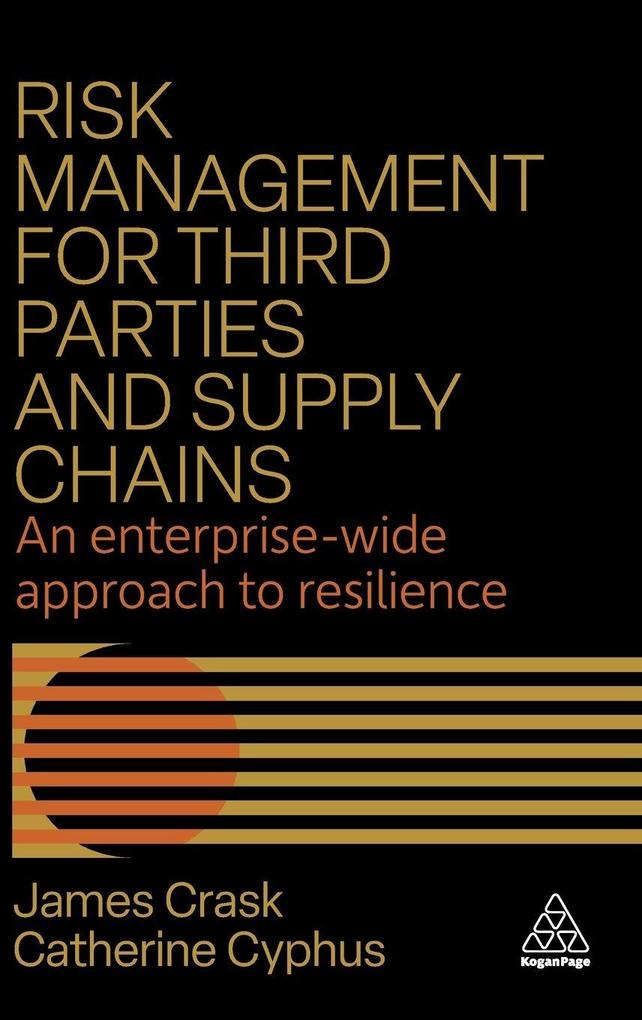
Strengthen business resilience and make informed decisions across complex third-party and supply chain ecosystems.
Risk Management for Third Parties and Supply Chains gives senior leaders proven tools for governing risk, improving oversight and safeguarding operational continuity in a volatile global environment. With shifting regulations, geopolitical shocks and rising dependency on external partners, this book shows how to build a strategic, enterprise-wide approach that delivers measurable results.
Written by risk experts James Crask and Catherine Cyphus, the book examines the root causes of today's supply chain crisis and reveals how ineffective third-party management undermines performance, cost control and long-term stability. Through strategic models and real-world examples, it outlines how to establish governance structures, controls and decision frameworks that elevate resilience to an enterprise priority.
You'll learn how to:
- Apply proven tools for assessing, prioritizing and mitigating third-party and supply chain risks
- Engage senior stakeholders and align risk initiatives with financial and strategic outcomes
- Balance cost efficiency with resilience to support informed leadership decisions
- Implement roadmaps, toolkits and deep-dive assessments to deliver repeatable results
With clear guidance on systems, controls and leadership engagement, this book equips executives to deliver a resilient third-party and supply chain risk management strategy that protects value across the organization.
Themes include: third-party risk, supply chain risk, supply chain resilience, governance models, enterprise risk, data-led decision making, operational continuity
Inhaltsverzeichnis
Section - ONE: The supply chain risk crisis - how did we get here? Chapter - 01: The business drivers for third party risk management Chapter - 02: Beyond procurement - the role of the wider business Chapter - 03: Balancing efficiency and resilience Chapter - 04: Universal vulnerabilities Chapter - 05: Real-world examples in good (and bad) supply chain risk management Chapter - 06: An enterprise-wide approach to managing third-party risk Chapter - 07: Strategies for supply chain resilience Section - TWO: Implementation Chapter - 08: Implementation Part 1 - governance and reporting Chapter - 09: Implementation Part 2 - managing supply chain risks Chapter - 10: Implementation Part 3 - differences between industries Chapter - 11: The future supply chain resilience programme Chapter - 12: Conclusion Chapter - 13: Templates and guidance materials Chapter - 14: Supply Chain Risk Maturity Model