Bücher versandkostenfrei*100 Tage RückgaberechtAbholung in über 100 Filialen












Nur noch heute: 15% Rabatt11 auf die schönsten Geschenke mit dem Code MUTTERTAG
Jetzt einlösen
mehr erfahren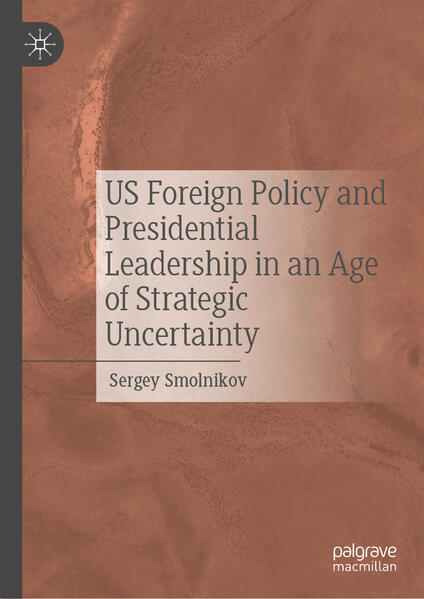
As the international system undergoes its most profound reordering since the end of the Cold War, the assumptions that once anchored America s global role are no longer analytically sufficient. Intensifying great-power rivalry, the weaponization of economic leverage, and accelerating geoeconomic polarization are reshaping the strategic environment faster than inherited explanatory frames can account for. This book advances a new conceptual architecture for interpreting US foreign policy transformative depth to distinguish among the policies that presidential administrations employ to reconstitute, reform, or stabilize the international order, or to minimize US engagement in its management. The framework clarifies the deeper logics through which the United States positions herself amid a tumultuous global transformation.
At the center of the study is a reconsideration of the modern presidency as a structurally pivotal force during periods of systemic inflection. Through a comparative examination of the leadership styles and decision-making practices of Presidents Obama, Trump, and Biden, the book shows how personality traits and professional backgrounds interact with external pressures to produce distinct trajectories in foreign, economic, and security policy. The result is a theoretically original and empirically grounded account of American statecraft in an era of global strategic uncertainty.
Inhaltsverzeichnis
Chapter 1: Introduction. - Chapter 2: Classifying America' s Foreign Policy Streams. - Chapter 3: Revolutionaries. - Chapter 4: Reformers. - Chapter 5: Stabilizers. - Chapter 6: Minimalists. - Chapter 7: Obama s Niebuhrian Worldview. - Chapter 8: Controversies of Obama s Policy in the Middle East. - Chapter 9: The Rise and Fall of Obama s Reset Policy on Russia. - Chapter 10: Obama s Pivot to Asia : Addressing the China Challenge. - Chapter 11: Trump' s " America First" Policy: Potential Implications for International Security and World Order. - Chapter 12: Trump s Impact on Shifts in the European Security and Defense Policy. - Chapter 13: Trump s Policies on Trade with China and Pacific Partnership. - Chapter 14: The Politics of Risk Aversion. - Chapter 15: Biden s Dual-Track Policy of Competing with China. - Chapter 16: Biden s Approach to the Russia-Ukraine War. - Chapter 17: Conclusion.
Es wurden noch keine Bewertungen abgegeben. Schreiben Sie die erste Bewertung zu "US Foreign Policy and Presidential Leadership in an Age of Strategic Uncertainty" und helfen Sie damit anderen bei der Kaufentscheidung.