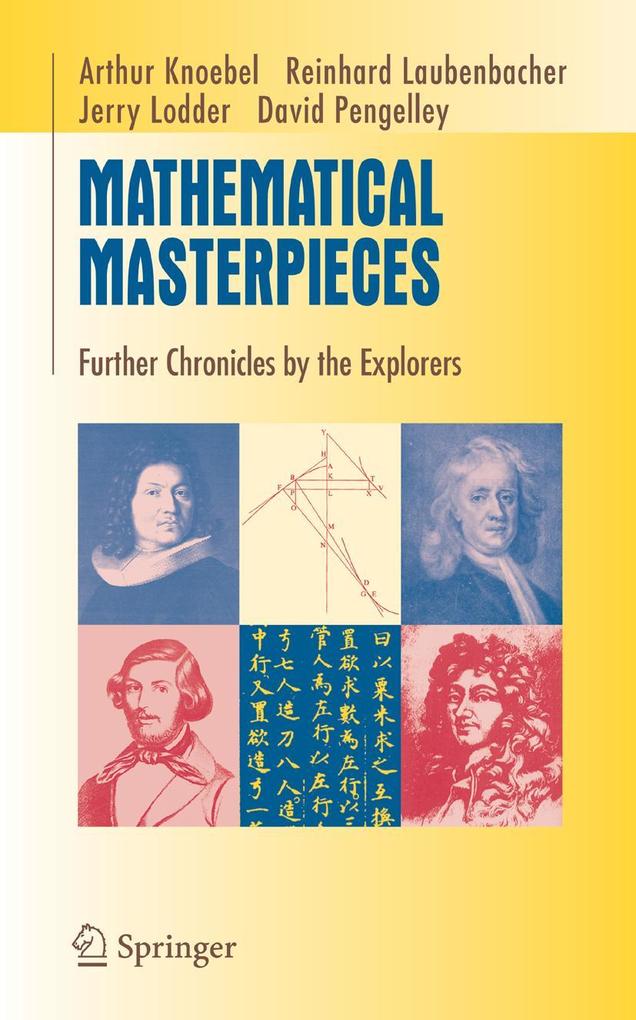
Advanced undergraduates will find here an introduction to the excitement of mathematical discovery, through close examination of original historical sources. Each chapter is anchored by a different story sequence of selected primary sources showcasing a masterpiece of mathematical achievement, illustrated by mathematical exercises and historical photographs.
In introducing his essays on the study and understanding of nature and e- lution, biologist Stephen J. Gould writes: [W]e acquire a surprising source of rich and apparently limitless novelty from the primary documents of great thinkers throughout our history. But why should any nuggets, or even ? akes, be left for int- lectual miners in such terrain? Hasn't the Origin of Species been read untold millions of times? Hasn't every paragraph been subjected to overt scholarly scrutiny and exegesis? Letmeshareasecretrootedingeneralhumanfoibles. . . . Veryfew people, including authors willing to commit to paper, ever really read primary sources-certainly not in necessary depth and completion, and often not at all. . . . I can attest that all major documents of science remain cho- full of distinctive and illuminating novelty, if only people will study them-in full and in the original editions. Why would anyone not yearn to read these works; not hunger for the opportunity? [99, p. 6f] It is in the spirit of Gould's insights on an approach to science based on p- mary texts that we o? er the present book of annotated mathematical sources, from which our undergraduate students have been learning for more than a decade. Although teaching and learning with primary historical sources require a commitment of study, the investment yields the rewards of a deeper understanding of the subject, an appreciation of its details, and a glimpse into the direction research has taken. Our students read sequences of primary sources.
Inhaltsverzeichnis
The Bridge Between Continuous and Discrete. - Solving Equations Numerically: Finding Our Roots. - Curvature and the Notion of Space. - Patterns in Prime Numbers: The Quadratic Reciprocity Law.