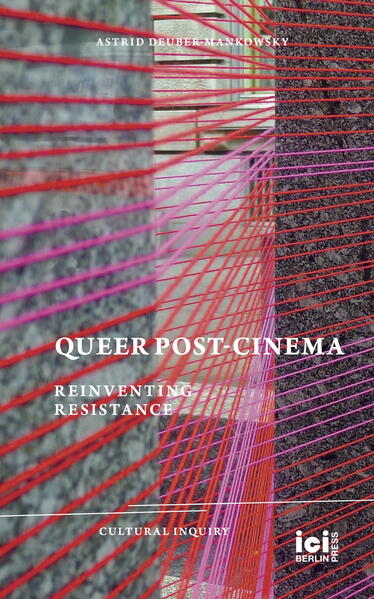
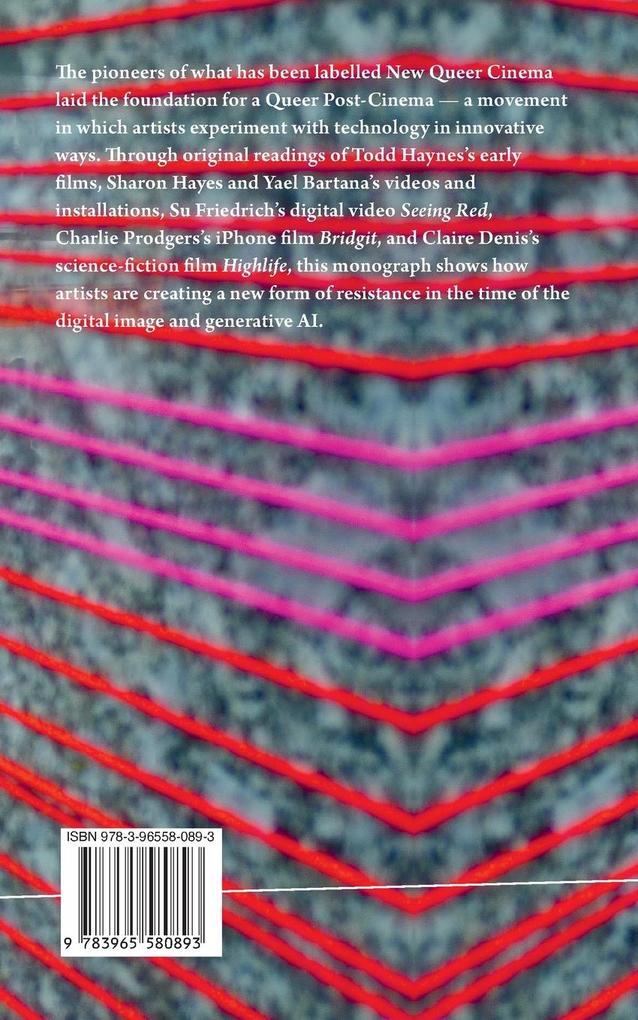
Astrid Deuber-Mankowsky s insightful and cautiously hopeful new book reads as a revelation. This series of stunning essays is framed by a magisterial introduction that traces our own post-cinematic moment back to New Queer Cinema productively redefining both by means of this unanticipated mash-up and concludes with a moving and compelling coda on immersive technologies and artificial intelligence. Informed throughout by enviously accessible expositions of queer theory, affect theory, and psychoanalysis, and drawing especially on the thought of Gilles Deleuze and Jacques Derrida, the volume is as lucid in its sustained intent as it is exacting in its analysis. Deuber-Mankowsky critically excavates models of queer resistance across an eclectic but nonetheless coherent range of media, ultimately coming to champion an ethic of the interstice: revealing an open field of possibility where nothing less than the future itself is at stake. Ian Fleishman, Chair of Cinema & Media Studies, University of Pennsylvania
In the course of taking us through the emergence of post-cinema and its digital forms (from vlogs to iPhone videos, from CGI to AI), Deuber-Mankowsky brilliantly shows why, and how, queer challenges to sexual difference and sexual identity are challenges to their forms of media. Questions of subjectivity, history, futurity, documentation, the archive, the gamed, the timed, and the biopolitical are explored in Deuber-Mankowsky s argument that revolutions and dissolutions of sex are made possible by the media that might otherwise be construed as their means of expression. Engaging Kara Keeling on the violence of forms that are `hostile to the change and chance immanent in each now Deuber-Mankowsky presents queer post-cinema as resisting that violence. It is, she argues, less a new aesthetic genre than an invitation to grasp the potential within form. In a further twist, the consequences of this understanding of the post-cinematic are shown to impact testimony, survival, even the `technology of reproductive technology. Penelope Deutscher, Joan and Sarepta Harrison Professor, Department of Philosophy, Northwestern University.