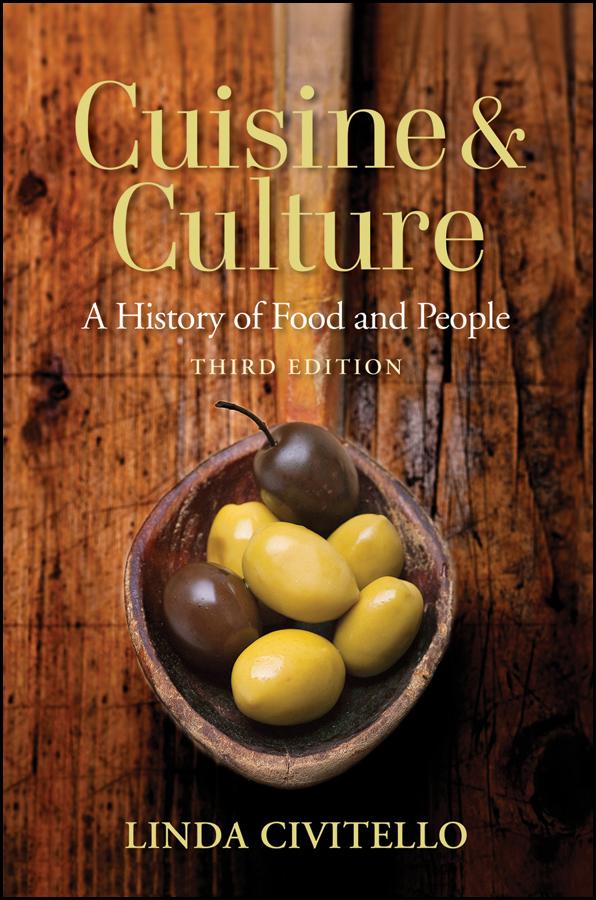
A fascinating look at how history and culture shape our diets Why did Americans once believe Italian food was very bad for you? When was sugar a medicine prescribed by doctors? What do Hawaiian sweet bread, Japanese tempura, and Indian vindaloo have in common? How did the Aztecs use tamales in religious festivals? And what's on the menu at a 700-seat McDonald's in Beijing? Cuisine and Culture, Third Edition answers these questions and many more with an informative and witty exploration of the many ways food, culture, and history intersect and influence each other.
From prehistory and the discovery of fire to modern cuisines and celebrity chefs, this book uses a global, multicultural approach to explain how major historical events have affected and defined culinary traditions in different societies around the world. This indispensable new Third Edition is more comprehensive and insightful than ever, featuring:
- New cuisines and cultures-including Norwegian, Ethiopian, Canadian, and Mayan
- More detailed coverage of Japanese, ancient Greek and Roman, and regional Indian and African cuisines
- New content on modern food technology and food marketing
- French and Italian pronunciation guides, a chronology of food books and cookbooks of historical importance, and an extensive bibliography
- Enlightening Holiday Histories, Food Fables, Food Chronologies, and historical recipes and menus
A thorough examination of the way history, culture, politics, wars, and religion determine how and what we eat, Cuisine and Culture, Third Edition is an essential guide for students, historians, and food lovers.
Inhaltsverzeichnis
Antipasto/Antojitos/Amuse-Bouches: Food for Thought viii Acknowledgments xii
FIRST COURSE:
From Raw to Cooked: Prehistory, Mesopotamia, Egypt, China, India 1
Prehistory 1
The Ancient Agricultural Revolution 5
The Fertile Crescent 9
Egypt: The Nile River 13
China: The Yellow (Huang He) River 18
India: The Indus River 21
SECOND COURSE:
Grain, Grape, Olive: The Ancient Mediterranean 25
The Mediterranean Sea 25
Greece 26
Rome 38
THIRD COURSE:
Crazy Bread, Coff ee, and Courtly Manners: Christendom and Islam in the Middle Ages, 500-1453 58
Christendom: Western Europe, 500-1000 59
Byzantium: The Eastern Roman Empire 65
The Muslim Empire 67
Christendom: The Late Middle Ages in Europe 74
FOURTH COURSE:
New World Food: Potato, Corn, Chile, Chocolate 89
The Search for Spices 89
The American Empires 92
South America: The Inca Empire 93
Central America: Vanilla 101
Central America: Maya Mystery 103
Central America: The Aztec Empire 107
North America: Cahokia 116
Columbus Sets Sail for the Americas: 1492 116
FIFTH COURSE:
Food Goes Global: The Columbian Exchange 119
The Age of Exploration 119
The Columbian Exchange 120
Old World to New 121
New World to Old 136
SIXTH COURSE:
America from Colony to Country: Sacred Cod, Black Rice, Maple Moon, 1588-1850 151
The Mercantile System 151
Colonial America 152
A New People and a New Cuisine 167
SEVENTH COURSE:
Hutsepot, Stove Potatoes, and Haute Cuisine: Seventeenthto Eighteenth-Century Dutch, Russian, and French Cuisine 182
The Scientific Revolution 182
The Golden Age of the Netherlands 183
The Russian Bear 189
France: Haute and Nouvelle Cuisine 195
The French Revolution: "Let Them Eat Cake" 203
The Napoleonic Era: 1799-1815 207
Napoleon's Aftermath 215
EIGHTH COURSE:
Cattle, Coca-Cola, Cholera: The United States and Europe, 1850-1900 217
The American South 217
The American Civil War: 1850-1865 220
Reconstruction: 1865-1877 223
The West: Railroad and Indian Wars, 1860s-1886 225
The Gilded Age 231
Nineteenth-Century Health Food Movements 240
Europe: Nutrition, Sanitation, Evolution 244
NINTH COURSE:
Africa and Asia: Native vs. Colonial Cuisine 258
Food Patterns 258
Africa: Shea Butter, Kola Nuts, Monkey Bread 258
India: Not Just Curry and Chutney 266
China: Tea and Opium 274
Korea: Kimchee and Pulgogi 282
Vietnam: Spring Rolls and Pâ té 283
Indonesia: The Spice Islands 283
The Philippines: Chinese-Spanish Fusion 285
Thailand (Siam): Lemongrass and Jasmine Rice 285
Japan: Tempura and Umami 287
TENTH COURSE:
The Purity Crusade, Cuisine Classique, and Prohibition: 1900-1929 in Europe and the United States 295
The New Immigrants and the Melting Pot 295
Progressives and the Purity Crusade 300
Escoffi er and Ritz: Cuisine Classique and the Grand Hotels 309
World War I and the Russian Revolution 316
The Roaring Twenties in the United States 323
ELEVENTH COURSE:
Soup Kitchens, Spam, and TV Dinners: The Depression, World War II, and the Cold War 334
The Depression and the New Deal 334
World War II 343
The Cold War 352
The Fast-Food Fifties 354
The Sixties: Revolutions in Color 359
TWELFTH COURSE:
Agribusiness vs. Organic: The 1970s into the Third Millennium 364
The Seventies: Food Revolutions 364
The Eighties: Political and Restaurant Revolutions 367
The Nineties: The Celebrity Chef 373
The New Millennium and the Future of Food 381
Appendix A: French Pronunciation 404
Appendix B: Italian Pronunciation 405
Appendix C: Major Wars and Battles 406
Appendix D: Selected Cookbook and Food Books Chronology 408
Notes 411
Selected Bibliography 424
Index 431