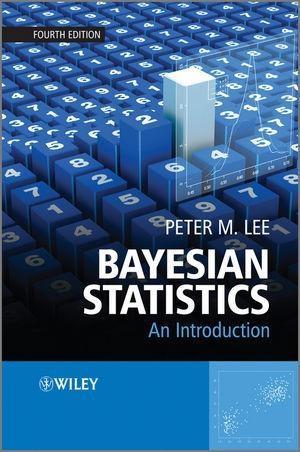
Bayesian Statistics is the school of thought that combines prior
beliefs with the likelihood of a hypothesis to arrive at posterior
beliefs. The first edition of Peter Lee's book appeared in
1989, but the subject has moved ever onwards, with increasing
emphasis on Monte Carlo based techniques.
This new fourth edition looks at recent techniques such as
variational methods, Bayesian importance sampling, approximate
Bayesian computation and Reversible Jump Markov Chain Monte Carlo
(RJMCMC), providing a concise account of the way in which the
Bayesian approach to statistics develops as well as how it
contrasts with the conventional approach. The theory is built up
step by step, and important notions such as sufficiency are brought
out of a discussion of the salient features of specific
examples.
This edition:
* Includes expanded coverage of Gibbs sampling, including more
numerical examples and treatments of OpenBUGS, R2WinBUGS and
R2OpenBUGS.
* Presents significant new material on recent techniques such as
Bayesian importance sampling, variational Bayes, Approximate
Bayesian Computation (ABC) and Reversible Jump Markov Chain Monte
Carlo (RJMCMC).
* Provides extensive examples throughout the book to complement
the theory presented.
* Accompanied by a supporting website featuring new material and
solutions.
More and more students are realizing that they need to learn
Bayesian statistics to meet their academic and professional goals.
This book is best suited for use as a main text in courses on
Bayesian statistics for third and fourth year undergraduates and
postgraduate students.