Bücher versandkostenfrei*100 Tage RückgaberechtAbholung in über 100 Filialen
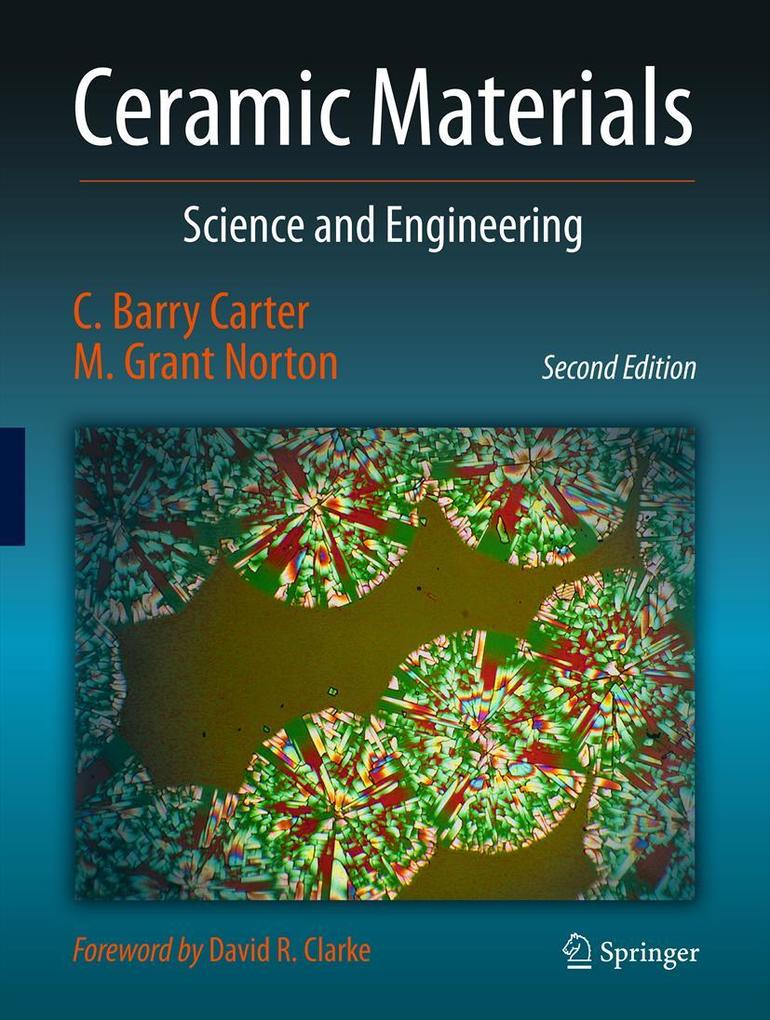
Ceramic Materials: Science and Engineering is an up-to-date treatment of ceramic science, engineering, and applications in a single, comprehensive text. Building on a foundation of crystal structures, phase equilibria, defects, and the mechanical properties of ceramic materials, students are shown how these materials are processed for a wide diversity of applications in today's society. Concepts such as how and why ions move, how ceramics interact with light and magnetic fields, and how they respond to temperature changes are discussed in the context of their applications. References to the art and history of ceramics are included throughout the text, and a chapter is devoted to ceramics as gemstones. This course-tested text now includes expanded chapters on the role of ceramics in industry and their impact on the environment as well as a chapter devoted to applications of ceramic materials in clean energy technologies. Also new are expanded sets of text-specific homework problems and other resources for instructors. The revised and updated Second Edition is further enhanced with color illustrations throughout the text.
Integrates the excitement of new advances in ceramics, including nanotechnology, medicine and clean energy, with fundamental concepts such as structure and defects
Explores the environmental and economic impact of ceramics on society
Describes the use of ceramics as the basis for many of today's critical technologies, including drug delivery, orthopedic implants, sensors and catalysis
Presents a comprehensive discussion on how today's ceramics are processed, from nanotubes and thin films to bottles and toilets
Offers abundant examples and full-color illustrations relating theory to practical applications
Addresses undergraduate and graduate teaching needs and provides a comprehensive reference for all scientists and engineers
Written by established and successful teachers and authors with experience in education, research and industry
Praise for Ceramic Materials:
"The unprecedented completeness of this book makes it a bible on ceramic materials. It is a must read textbook for researchers, graduate students and undergraduate students who are interested in ceramics." -- Zhong Lin Wang, Regents' Professor, The Hightower Chair in Materials Science and Engineering, Georgia Institute of Technology
". . . an outstanding introduction to the subject, clearly written, very detailed, and actually fun and quite easy to read for anyone with some basic scientific background. Each chapter contains several exercises, which this reviewer found to be very helpful. I also found extremely useful the shaded boxes on almost every page with short definitions plus "people in history". After being exposed to many books on ceramic science during my 40-year career, I finally found a book with which I can restart my ceramic education again." --Antoni Tomsia, Lawrence Berkeley National Laboratory
". . . a valuable resource for the materials science and engineering community, both as a textbook and as a general reference to this important field. . . . recommended reading and a serious study source for anyone interested in ceramics. . ." --Richard W. Siegel, Director, Rensselaer Nanotechnology Center, Rensselaer Polytechnic Institute
"The book is just wonderful, and one can only envy what the authors have done! It is the best book I have seen to date. Very clearly written with excellent examples and explanations [as well as] beautiful figures and photographs." --Professor Safa Kasap, Canada Research Chair in Electronic and Optoelectronic Materials, University of Saskatchewan
"This new book. . . covers all important topics including history, microstructures, tools, defects, mechanical properties and processing of ceramics for understanding and solving the problems of ceramic science and engineering, . . ." --Yuichi Ikuhara, The University of Tokyo
"This is a comprehensive text covering, as the ti
Inhaltsverzeichnis
Preface to the First Edition. - Preface to the Second Edition. - Foreword. - PART I: History and Introduction. - Chapter 1: Introduction. - Chapter 2: Some History. - PART II: Materials. - Chapter 3: Background You Need to Know. - Chapter 4: Bonds and Energy Bands. - Chapter 5: Models, Crystals and Chemistry. - Chapter 6: Binary Compounds. - Chapter 7: Complex Crystal and Glass Structures. - Chapter 8: Equilibrium Phase Diagrams. - PART III: Tools. - Chapter 9: Furnaces. - Chapter 10: Characterizing Structure, Defects and Chemistry. - PART IV: Defects. - Chapter 11: Point Defects, Charge and Diffusion. - Chapter 12: Are Dislocations Unimportant? . - Chapter 13: Surfaces, Nanoparticles and Foams. - Chapter 14: Interfaces in Polycrystals. - Chapter 15: Phase Boundaries, Particles and Pores. - PART V: Mechanical Strength and Weakness. - Chapter 16: Mechanical Testing. - Chapter 17: Plasticity. - Chapter 18: Fracturing: Brittleness. - PART VI: Processing. - Chapter 19: Raw Materials. - Chapter 20: Powders, Fibers, Platelets and Composites. - Chapter 21: Glass and Glass-Ceramics. - Chapter 22: Sols, Gels and Organic Chemistry. - Chapter 23: Shaping and Forming. - Chapter 24: Sintering and Grain Growth. - Chapter 25: Solid-State Phase Transformations & Reactions. - Chapter 26: Processing Glass and Glass-Ceramics. - Chapter 27: Coatings and Thick Films. - Chapter 28: Thin Films and Vapor Deposition. - Chapter 29: Growing Single Crystals. - PART VII: Properties and Applications. - Chapter 30: Conducting Charge or not. - Chapter 31: Locally Redistributing Charge. - Chapter 32: Interacting with & Generating Light. - Chapter 33: Using Magnetic Fields & Storing Data. - Chapter 34: Responding to Temperature Changes. - Chapter 35: Ceramics in Biology & Medicine. - Chapter 36: Minerals & Gems. - Chapter 37: Energy Production and Storage. - Chapter 38: Industry and the Environment.
From the book reviews:
I will definitely select this book as a textbook for a class on this subject. The book includes general backgrounds materials, the basics of ceramic materials science and advanced applications of ceramic science and technology. Therefore, non-specialists (even non-science majors) including undergraduate, and graduate students as well as experts in the field can learn from various parts of in this book. (Katsuhiko Ariga, Journal of Inorganic and Organometallic Polymers and Materials, Vol. 24, 2014)
Es wurden noch keine Bewertungen abgegeben. Schreiben Sie die erste Bewertung zu "Ceramic Materials" und helfen Sie damit anderen bei der Kaufentscheidung.