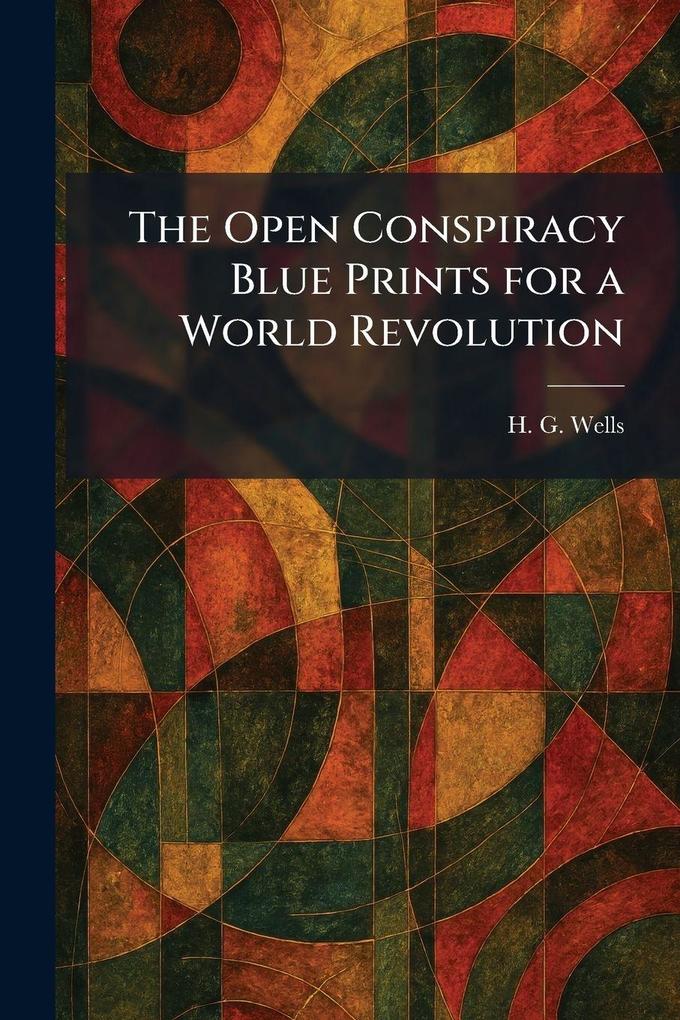
"The Open Conspiracy Blue Prints for a World Revolution" is a profound social and political manifesto by H.G. Wells that outlines his vision for a global restructuring of human society. In this seminal work, Wells argues for the creation of a unified world state, governed by scientific principles and collective reason, to replace the fragmented and often destructive nature of individual nation-states. He explores the necessity of a "conspiracy" of enlightened individuals-scientists, engineers, and thinkers-who would work together to establish a new world order focused on education, economic stability, and the advancement of humanity.
Wells details the practical steps required for this peaceful revolution, emphasizing the transition from traditional religious and patriotic loyalties toward a broader commitment to the global community. The work reflects Wells's enduring belief in the power of human intellect to solve global crises and prevent future conflicts. By addressing themes of technological progress, social equity, and the rational organization of resources, "The Open Conspiracy Blue Prints for a World Revolution" remains a significant contribution to early 20th-century political philosophy and utopian thought, offering a provocative blueprint for a sustainable and integrated future for all of mankind.
This work has been selected by scholars as being culturally important, and is part of the knowledge base of civilization as we know it. This work was reproduced from the original artifact, and remains as true to the original work as possible. Therefore, you may see the original copyright references, library stamps (as most of these works have been housed in our most important libraries around the world), and other notations in the work.
This work is in the public domain in the United States of America, and possibly other nations. Within the United States, you may freely copy and distribute this work, as no entity (individual or corporate) has a copyright on the body of the work.
As a reproduction of a historical artifact, this work may contain missing or blurred pages, poor pictures, errant marks, etc. Scholars believe, and we concur, that this work is important enough to be preserved, reproduced, and made generally available to the public. We appreciate your support of the preservation process, and thank you for being an important part of keeping this knowledge alive and relevant.