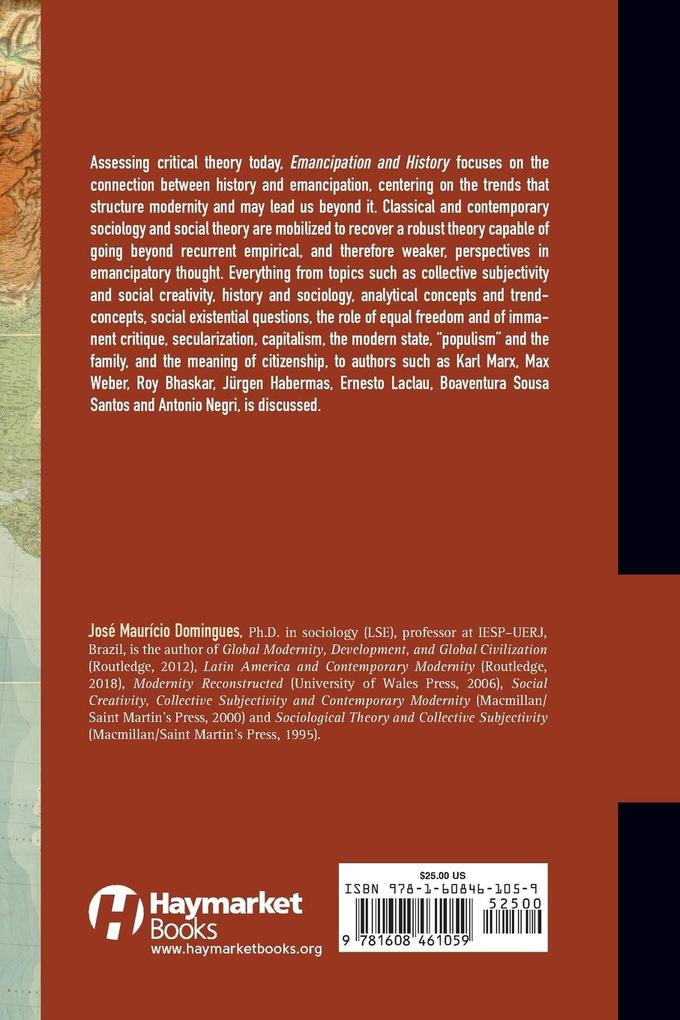
Emancipation and History assesses critical theory today, focusing on the connection between history and emancipation and on the trends that structure modernity and may lead us beyond it.
Inhaltsverzeichnis
List of Illustrations
Introduction
1 Vicissitudes and Possibilities of Critical Theory Today
Defining Critical Theory
Contemporary Modernity
Renewing Critique
2 Global Modernity: Levels of Analysis and Conceptual Strategies
Introduction
Levels of Analysis
Descriptions
Middle-range Analytical Concepts
General Analytical Concepts
A Trend-concept: Secularization
Conclusion
3 Existential Social Questions, Developmental Trends and Modernity
The Problem
Existential Social Questions
Existential Questions, Developmental Trends and Modernizing Moves
Final Words
4 History, Sociology and Modernity
Introduction
Historical Sociology and Sociological Theory
Theory and Mechanisms
Conclusion
5 Realism, Trend-concepts and the Modern State
Introduction
Beyond Empiricism (and Critical Realism)
The Modern State and Modern Society
Collective Subjectivity, Mechanisms, Modernization
Final Words
6 Family, Modernization and Sociological Theory
Two Intertwined Themes
Globalization and Modernization
The Family, the “dimensions” of Social Life and the “existential questions”
Conclusion
7 The Basic Forms of Social Interaction
Introduction
Principles of Organization, Mechanisms of Coordination
Principles of Antagonism, Mechanisms of Opposition
Coordination, Antagonism
Interactive Inclinations
Bases of Justification
Conclusion
8 The Imaginary and Politics in Modernity: The Trajectory of Peronism
Introduction
Theoretical Background
Historical Peronism
The Argentina of Kirchner and Fernández de Kirchner
The Imaginary and Politics in Modernity
9 Critical Social Theory and Developmental Trends, Emancipation and Late Communism
Introduction
Capitalism, Accumulation and Communism
Contemporary Alternatives
Tasks of Critical Theory – or Late Twentieth Century Communism
References
Index