Bücher versandkostenfrei*100 Tage RückgaberechtAbholung in über 100 Filialen
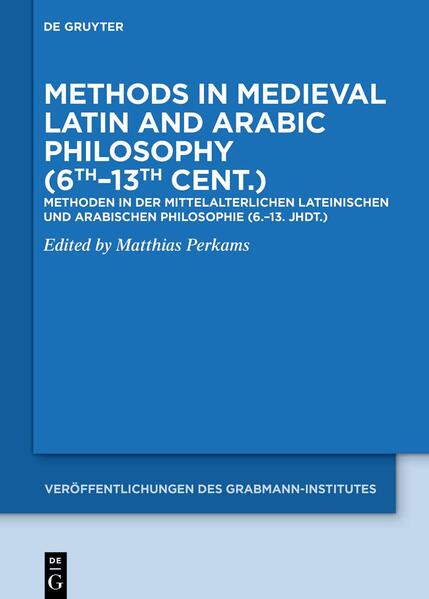
The topic of this volume consists in discussing the methods used in the different areas of philosophy during the Latin Middle Ages and in the Islamicate world. The different contributions treat the methods of logic, ethics, philosophical psychology, physics, the mathematical disciplines and metaphysics from the end of antiquity towards the thirteenth/fourteenth century. The articles explain the respective roles of logic and of experiments as well as those of mathematics as a model of a purely rational endeavor within the different fields of philosophical research. Thus, the collection gives an impression of how Latin and Arabic thinkers understood and developed the Aristotelian idea that the specific methods of one philosophical discipline cannot be applied in the same way to any other subject area. As a result, a variety of perspectives on what good philosophical practice can look like emerge from both cultural spheres. The volume contributes to comparative studies in the History of Philosophy as well as to actual discussions on philosophical methods.
Begründet von Michael Schmaus , Werner Dettloff und Richard Heinzmann
Fortgeführt unter Mitwirkung von Ulrich Horst
Herausgegeben von Isabelle Mandrella und Martin Thurner
Das Grabmann-Institut ist eine im deutschsprachigen Raum einzigartige Einrichtung zur Erforschung und Lehre der Theologiegeschichte. Es wurde 1953 von Michael Schmaus als Institut zur Erforschung der mittelalterlichen Theologie und Philosophie gegründet, das die Forschungen und die Tradition des Vorgängers von Schmaus auf dem Münchener Lehrstuhl für Dogmatik, Martin Grabmann, fortführen soll. In der Reihe "Veröffentlichungen des Grabmann-Instituts" werden Editionen und Studien publiziert, die entweder am Grabmann-Institut selbst entstanden sind oder einen wertvollen Beitrag zu dessen Forschungsschwerpunkten beinhalten. Das Schwergewicht der Publikationsreihe liegt auf der mittelalterlichen Theologie und Philosophie, wobei sich der zeitliche Bogen aber von der ausgehenden Antike bis in die Neuzeit spannt. Das historische Interesse verbindet sich mit dem systematischen Blickwinkel. In den Bänden werden Themen aus allen systematischen Bereichen der mittelalterlichen Theologie und Philosophie behandelt sowie herausragende und bisher weniger bekannte Theologen mit ihren Werken und ihrem Einfluss vorgestellt. Gebührende Berücksichtigung finden auch die Gebiete Mystik und Spiritualität, die wesentlich zur mittelalterlichen Theologie und Philosophie gehören.
Zum Martin-Grabmann-Forschungsinstitut für Mittelalterliche Theologie und Philosophie.
Es wurden noch keine Bewertungen abgegeben. Schreiben Sie die erste Bewertung zu "Methods in Medieval Latin and Arabic Philosophy (6th-13th cent.)" und helfen Sie damit anderen bei der Kaufentscheidung.