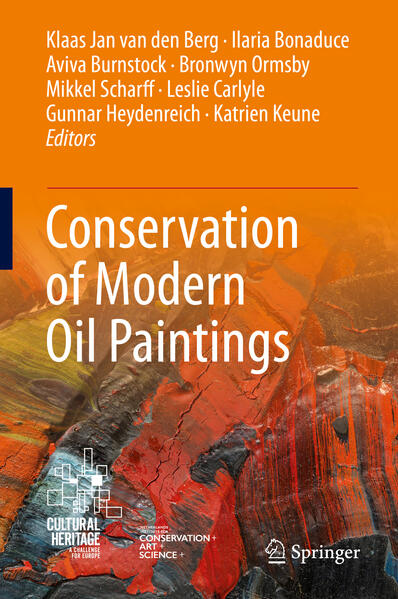
Artists oil paints have become increasingly complex and diverse in the 20
th
Century, applied by artists in a variety of ways. This has led to a number of issues that pose increasing difficulties to conservators and collection keepers. A deeper knowledge of the artists intent as well as processes associated with material changes in paintings is important to conservation, which is almost always a compromise between material preservation and aesthetics.
This volume represents 46 peer-reviewed papers presented at the Conference of Modern Oil Paints held in Amsterdam in 2018. The book contains a compilation of articles on oil paints and paintings in the 20th Century, partly presenting the outcome of the European JPI project `Cleaning of Modern Oil Paints . It is also a follow-up on `Issues in Contemporary Oil Paint (Springer, 2014).
The chapters cover a range of themes and topics such as: patents and paint manufacturing in the 20th Century; characterization of modern-contemporary oil paints and paint surfaces; artists materials and techniques; the artists voice and influence on perception of curators, conservators and scientists; model studies on paint degradation and long term stability; approaches to conservation of oil paintings; practical surface treatment and display.
The book will help conservators and curators recognise problems and interpret visual changes on paintings, which in turn give a more solid basis for decisions on the treatment of these paintings.
Inhaltsverzeichnis
Challenges in research: Connecting scientific analysis with conservation practice. - Evaluating cleaning systems for use on water sensitive modern oil paints: a comparative study. - Paint Technology. - Pigment Surface Treatments: 20th and 21st century industrial techniques and strategies for their detection. - Meet the future: the creation of new pigments. - Zinc oxide in oil-based house paint: Insights from a paint chemist s notebook dated 1949. - A Glimpse into the House and Decorative Paint Market in Norway During World War I (1914 1918). - Approaches to the identification of Royal Talens ETA (emulsion) paint in objects of art. - Synthetic organic pigments in Royal Talens oil paint 1920-1950 The case of vermillion
imit
. -
Case studies: artists techniques and materials; degradation; ethical considerations; treatment options. -
Ellsworth Kelly: The Studio and Beyond. - A new vocabulary of color: Bocour oil paints and Barnett Newman. - Analysis of Modern Paints and Conservation at the Clyfford Still Museum. - Pigments of Soviet Artists in the 1950s - late 70s. - A View Through the Meander: A Study of Knifer s Oil Paintings from the 1960s. - Preservation of Russian Abstract Art of the Second Part of the 20th Century. - Investigating colour changes in red and blue paints a preliminary study of art materials and techniques in Edvard Munch s
Old Man in Warnemünde
(1907). - Aspects of Lovis Corinth s Painting Technique in his late Work: Working Process and Colour Structure captured in Paint and on Film. - Oil paint straight from the tube: paint-specific deterioration in works by Alexis Mérodack-Jeaneau, 1910-1913. - Picasso 1917: Failure Mechanisms in the Paint Layers of Four Artworks. - Investigation on the
speckles syndrome
affecting late 1920s oil paintings by René Magritte. - Diagnosis and conservation process of major curled-up delaminated areas in a black oil painting from 1960 by Pierre Soulages. -Examination of paint delamination in
C' est grace à nous
by Asger Jorn. - A synchrotron photoluminescence microscopy study into the use and degradation of zinc white in
The Woodcutters
by Bart van der Leck. - `Breaking waves . The relation between zinc-oxide degradation in a ground layer and extreme delamination on
Beach Scene
, by J. E. H. Akkeringa (1861-1942). - Efflorescence on the paintings of Edwin Austin Abbey: Examination, analysis, and cleaning of surface bloom on
The Spirit of Light
. - A Study of Softening and Liquefying Oil Paint on
Womenizer
by Alex Janvier; K. Helwig et al. - The Deterioration and Treatment of Some Late Paintings by Paul-Émile Borduas. - Colors before Zero: commercial alkyd-oil enamel paints in early reliefs by Jan J. Schoonhoven. - Some considerations when cleaning Robert Ryman s oil paint(ings). - Challenges of Surface Cleaning Paintings by Asger Jorn (1914-1973): An Inventory of Existing Practice. -Decision-making processes regarding the treatment of modern oil paintings (1950 s present) exhibiting paint dripping and oil exudates. - Between rejection, ignorance, and preference: The history and dilemma of modern double-sided (recto/verso) paintings with regard to issues of conservation and presentation. -
Model studies. -
Novel microscopic strategy for the study of paint cross-sections. - Investigations into the mechanical properties of commercial artists oil paint by Dynamic Mechanical (Thermal) Analysis (DMA), Nanoindentation (UNHT), and Dynamic Vapour Sorption (DVS). - A Preliminary Investigation into the Behavior of Modern Artists Oil Paints in a Hot and Humid Climate. - Inside the forger s oven: identification of drying products in oil paints during and after accelerated drying with increased temperatures. - The influence of metal stearates on the water sensitivity of modern oil paints. - The rate of solvent action on modern oil paint. -
Conservation treatment. -
Water-sensitivity in modern oil paintings: Trends in phenomena and treatment options. - Modern oil paintings in Tate s collection: a review of analytical findings and reflections on water sensitivity; . - Analytical study to monitor the effectiveness of a combined liquid-dispensing and micro-aspiration system for the cleaning of modern oil paintings. - Ketone resins varnishes on canvas paintings from the collection of the Munch Museum. - Designing mock-up paintings for a study of novel surface cleaning techniques for Munch s unvarnished Aula paintings. - Analysis of cleaning efficacy and clearance of silicone-based Pickering-type emulsions used in the cleaning of water-miscible oil paints. - Improving the surface cleaning of water sensitive oil paint by use of alternative application methods; M. Hintz et al. - Evolon® CR microfibre cloth as a tool for varnish removal. - Can Cellulosebeads save the
Circling of the Planets
? Cellulose-based consolidating filler to stabilise lifted brittle flakes on a large painting.