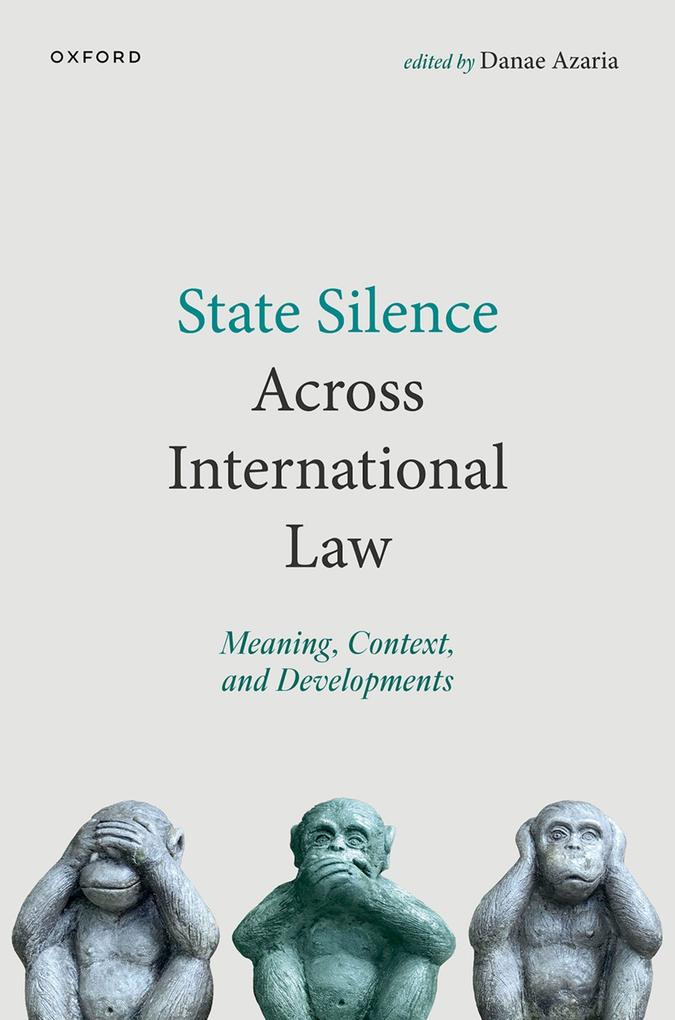
State Silence Across International Law examines the role of State silence and inaction in the formation of rules of international law. It explores how State silence can be interpreted in a range of contexts, including in relation to use of force, cyberspace, armed conflict, human rights, trade, boundaries, outer space, and the environment.
Inhaltsverzeichnis
- Part 1. General
- 1: Danae Azaria: Introduction
- 2: Omri Sender and Michael Wood: State Silence and the Work of the International Law Commission
- Part 2. Peace and Security
- 3: Danae Azaria: State Silence and the Law on the Use of Force
- 4: Duncan B. Hollis and Barrie Sander: State Silence and the International Law of Cyberspace,
- 5: Sandesh Sivakumaran: State Silence and the Law of Armed Conflict
- 6: Talita Dias: State Silence and International Criminal Law
- Part 3. International Human Rights Law
- 7: Andreas Zimmermann and Nils-Hendrik Grohmann: State Silence and the Framework of the ICCPR
- 8: Olivia Coral Daniels and Laurence R. Helfer: State Silence and the European Human Rights System
- Part 4. International Economic Law
- 9: Gabrielle Marceau and Rebecca Walker: WTO Members' Silence and WTO Decision-Making
- 10: Robert Howse: WTO Members' Silence and WTO Law
- 11: August Reinisch and Johannes Tropper: State Silence and International Investment Law
- Part 5. International Law of Spaces and the Environment
- 12: Giovanni Distefano and Aymeric Hê che: State Silence and Territorial Title and Boundaries
- 13: Jean-Marc Thouvenin: State Silence and the Law of the Sea
- 14: Lorenzo Gasbarri: State Silence and International Space Law
- 15: Malgosia Fitzmaurice: State Silence and International Environmental Law
- Part 6. Conclusion
- 16: Danae Azaria: Conclusion