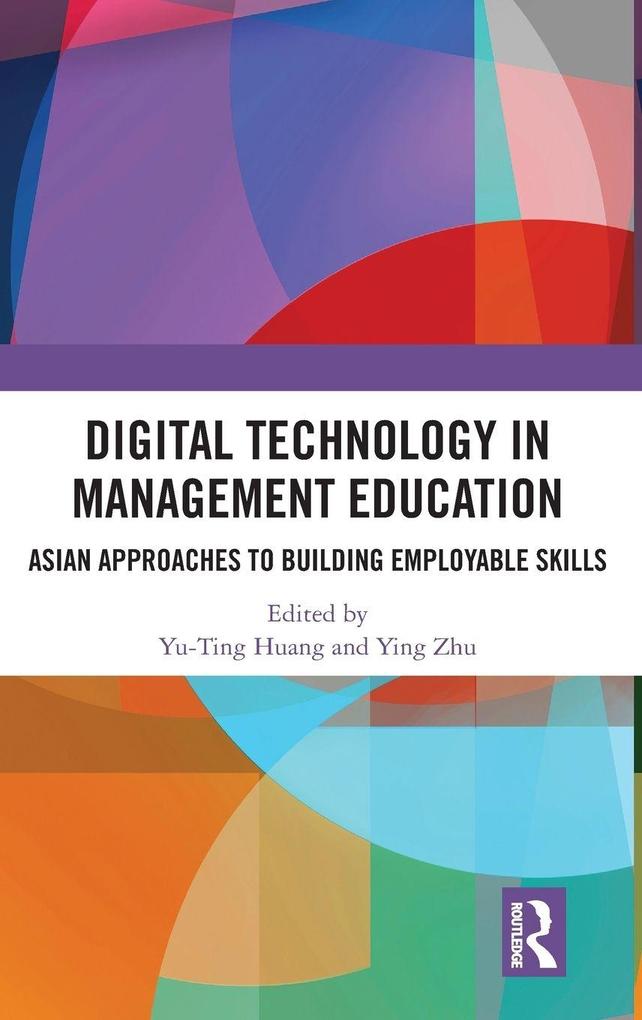
This book explores how different business schools in Asian countries are utilizing digital technologies and artificial intelligence (AI) in their programmes.
It looks at the challenges and opportunities of how business schools may achieve evidence-based programme development. Looking at business education in Asian countries such as Singapore, China, Taiwan, and Macau, the book then provides examples of how business schools are adopting AI and digital technology in curriculum reform and enhancing industry-academic integrated education. The book also looks at how schools may improve their students' digital literacy and AI competency.
This edited volume will interest policy makers, business education providers, and professionals engaged in industry-academic integration.
Inhaltsverzeichnis
Chapter 1: Introduction
Yu-Ting Huang and Ying Zhu
Chapter 2: Challenges and Opportunities of Adopting Digital Technology for Curriculum Reform
Yi-min Li
Chapter 3: Research on Digital Technology Integration in Tourism Marketing Education: A Practical Approach
Ping-Tsan Ho
Chapter 4: The Application Status and Prospects of Artificial Intelligence in Tourism Education in China
Wenjie Xiao, Yi Liu, and Jigang Bao
Chapter 5: Singapore's Spiral Laboratory of AI Futures: Business Education in an Age of Thresholds (2026-2046)
Mark King
Chapter 6: Co-Creation in Modern Business Education in Macau: Digital Technology and AI-based Innovative Practices in Agentic Marketing, E-Commerce and Decision Analysis
Caleb Huanyong Chen, Helmond Hio Nam Io, and Chunsheng Li
Chapter 7: AI Talent Cultivation and TRAM Impact in Business Education and Academia-Industry Collaboration
Peter J. Sher, Yi-Fang Chiang, Ting-Ting Chen
Chapter 8: New Thinking of Flipping the Classroom: Effects on Students' Concentration and Learning Outcomes by Applying ZUVIO and Monica AI to Support Differentiated Teaching
Shu-Ling Lin and Liang-Chih Liu
Chapter 9: Forging Future-Ready Business Leaders: Interplay Between Self-Efficacy, AI Anxiety, and Self-Perceived Employability
Alexis P.I. Goh
Chapter 10: Conclusion
Ying Zhu and Yu-Ting Huang