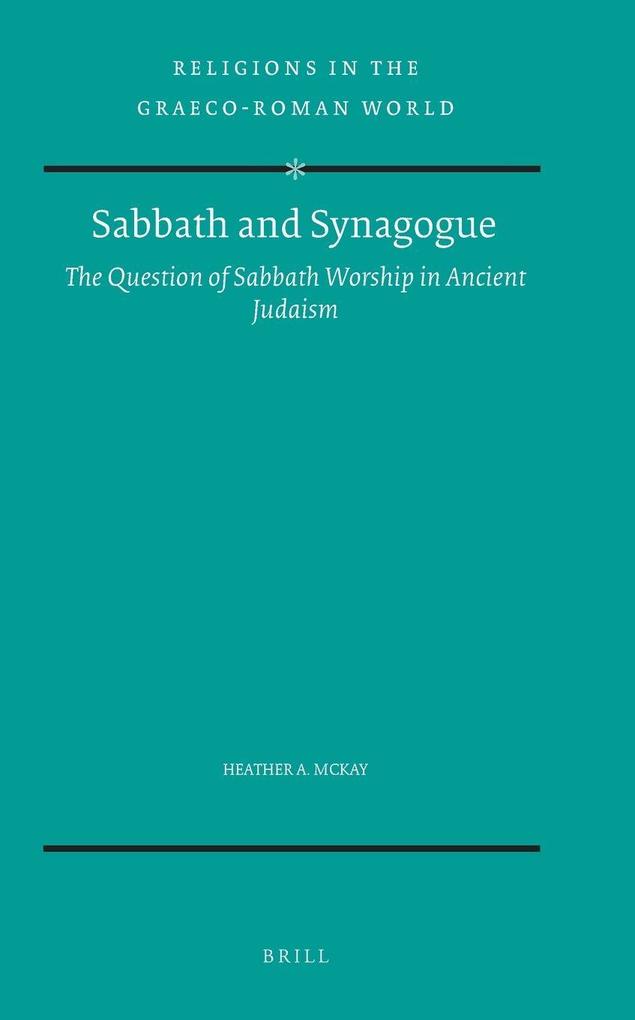
Sabbath worship as a communal event does not feature in the Hebrew Bible. In the context of the first century CE, according to Philo and Josephus, the sabbath gatherings took place only for the purpose of studying the law, and not for the liturgical recital of psalms or prayer. Classical authors depict Jews spending the sabbath at home. Jewish inscriptions provide no evidence of sabbath-worship in prayer-houses (proseuchai), while the Mishnah prescribes no special communal sabbath activities. The usual picture of Jews going on the sabbath to the synagogue to worship thus appears to be without foundation. It is even doubtful that there were synagogue buildings, for 'synagogue' normally meant 'community'. The conclusion of this study, that there is no evidence that the sabbath was a day of communal Jewish worship before 200 CE, has far-reaching consequences for our understanding of early Jewish-Christian relationships.
This publication has also been published in paperback, please click here for details.
Heather McKay, MSc, BD, Ph.D. (1992, Glasgow), Senior Lecturer in Religious Studies at Edge Hill College, Ormskirk, Lancashire, UK, teaches Contemporary Religions and Beliefs. She researches on Jewish and Christian use of the Old Testament and on feminist biblical criticism.
Bewertungen
0 Bewertungen
Es wurden noch keine Bewertungen abgegeben. Schreiben Sie die erste Bewertung zu "Sabbath and Synagogue" und helfen Sie damit anderen bei der Kaufentscheidung.