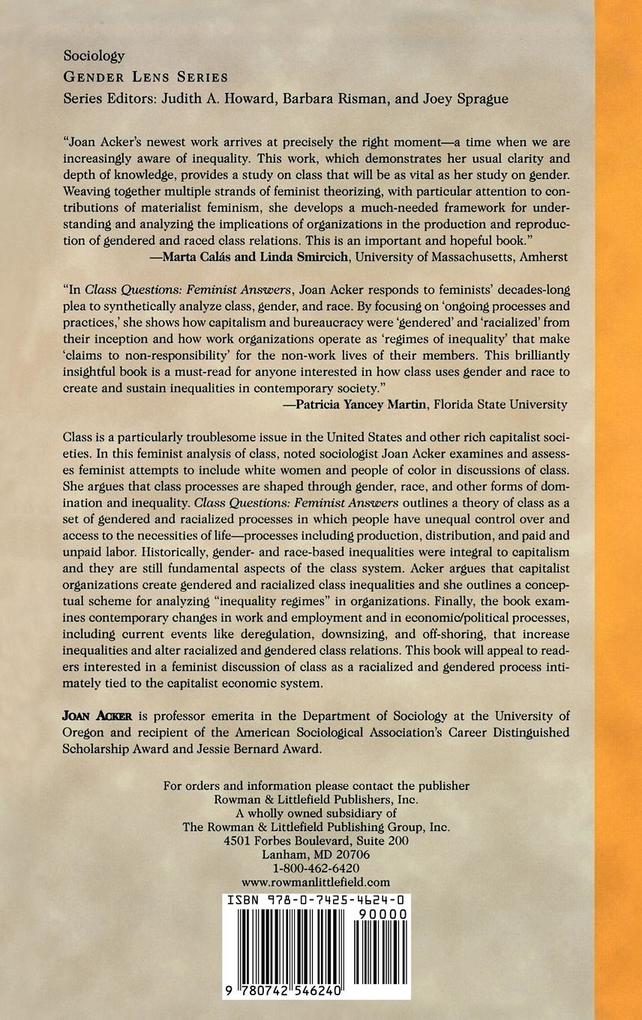
Joan Acker's newest work arrives at precisely the right moment-a time when we are increasingly aware of inequality. This work, which demonstrates her usual clarity and depth of knowledge, provides a study on class that will be as vital as her study on gender. Weaving together multiple strands of feminist theorizing, with particular attention to contributions of materialist feminism, she develops a much-needed framework for understanding and analyzing the implications of organizations in the production and reproduction of gendered and raced class relations. This is an important and hopeful book. -- Marta Calas and Linda Smircich, University of Massachusetts, Amherst Acker succeeds in breaking new ground by merging issues of class, race, and gender and the lenses through which they are viewed ... Her work does much to close the chasm that has existed between discussions of class and discussions of gender and race. Highly recommended. CHOICE [Acker's] presentation provides a useful overview of theories about class and gender, and readers should find it valuable to get a sense of conversations on these topics...The book is quite valuable...The challenge of accurately describing the world confronts all academics and social thinkers, and Acker provides a commendable addition to that effort. This book certainly stands as an accomplishment of a feminist theorization of class...Acker's account is a worthwhile read for those conceptualizing the connections between class, race, and gender. Feminist Economics, April 2008 In Class Questions: Feminist Answers, Joan Acker responds to feminists' decades-long plea to synthetically analyze class, gender, and race. By focusing on "ongoing processes and practices," she shows how capitalisms and bureaucracy were "gendered" and "racialized" from their inception and how work organizations operate as "regimes of inequality" that make "claims to non-responsibility" for the non-work lives of their members. This brilliantly insightful book is a must-read for anyone interested in how class uses gender and race to create and sustain inequalities in contemporary society. -- Patricia Yancey Martin, Florida State University Acker develops a framework for understanding and analysing the implications of organizations in the production and reproduction of gendered, race and class relations... Acker elevates the importance of class without ignoring gender and race. Equality, Diversity and Inclusion: An International Journal