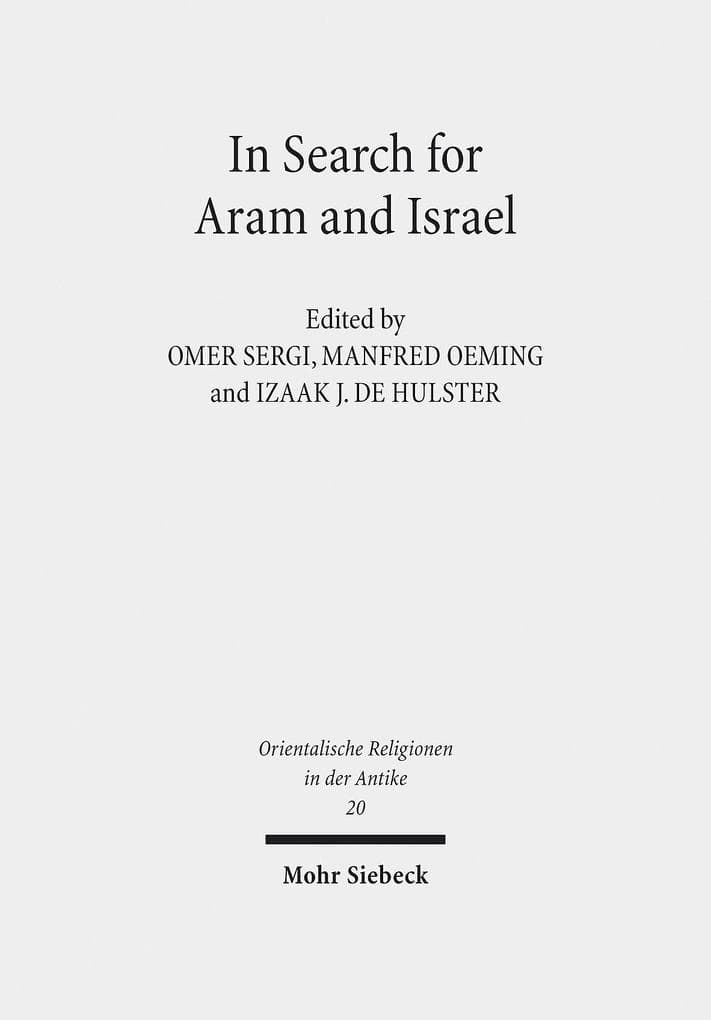
Die Autoren dieses Bandes präsentieren aktuelle Untersuchungen zum antiken Syrien und Israel mit einem Schwerpunkt auf den jeweiligen Entwicklungen und Charakteristika beider Kulturen in der Antike sowie auf dem interkulturellen Netzwerk, welches sie eng verbindet.
This congress volume of the Minerva Center for the Relations between Israel and Aram in Biblical Times combines theoretical approaches to historical research on autonomy or independence in ancient cultures and then presents articles which study the subject using Aram and Israel in antiquity as examples. These articles show clearly how strongly Syria and Palestine were linked to one another and how they constituted one single cultural region which was connected by its economy, politics, language, religion, and culture. Der vorliegende Kongressband des Minerva Center for the Relations between Israel and Aram in Biblical Times bündelt theoretische Ansätze zur historischen Forschung über Autonomie bzw. Unabhängigkeit in antiken Kulturen und schreitet fort zu Beiträgen, die das Thema am konkreten Beispiel von Aram und Israel in der Antike untersuchen. Dabei wird deutlich, wie stark Syrien und Palästina miteinander vernetzt waren, und einen einzigen kulturellen Raum bildeten, der durch Ökonomie, Politik, Sprache, Religion und Kultur verbunden war.
Inhaltsverzeichnis
Section III. Archaeological Perspecives on the Arameans in the Northern LevantDominik Bonatz: The Myth of Aramean Culture - Daniele Morandi Bonacossi: Iron Age Mishrifeh: An Aramean Specialized Production Center in the Hamath Kingdom?
Section IV. Archaeological Perspectives on the Aramean-Israelite Inter-relations in the Southern Levant
Shuichi Hasegawa: En Gev in the Iron Age II: Material Culture and Political History - Naama Yahalom-Mack/Nava Panitz-Cohen/Robert A. Mullins: An Iron Age I Cultic Context at Tel Abel Beth-Maacah - Adi Eliyahu-Behar/Vanessa Workman/Amit Dagan: Early Iron Production at Philistine Tell es-Safi/Gath vs. Israelite Tel Megiddo - Yifat Thareani: Archaeology of an Imagined Community: Tel Dan in the Iron Age IIa - Gunnar Lehmann: Hazael in the South - Assaf Kleiman: Invisible Kingdoms? Settlement Oscillations in the Northern Jordan Valley and State Formation in Southwestern Syria
Section V. Historical Perspectives on Aramean-Israelite Interactions
Omer Sergi: The Memory of the Kingdom of Geshur in Biblical Literature - Karel van der Toorn: Arameans and Israelites in Papyrus Amherst 63 - Christian Frevel: State Formation in the Southern Levant: The Case of the Arameans and the Role of Hazael' s Expansion - Herbert Niehr: The Relations between the Kingdoms of Hamath and Israel - Yuval Levavi: A Peculiar Taxation Practice of Judean Exiles in Rural Babylonia and its Possible Connection to Building Activity in Late Sixth Century Judah
Section VI. Historical Perspectives on Later Periods
Leeor Gottlieb: From Translation to Midrash: On the Role of Aramaic Targum towards the End of the First Millennium CE - Abraham Tal: Between Early and Late Samaritan Aramaic - John Healey: " Arameans" and Aramaic in Transition: Western Influences and the Roots of Aramean Christianity - Esther Eshel/Ian Stern: Divination Texts from Maresha - Marco Frenschkowski: Are Syrians Arameans? Some Preliminary Remarks on Syriac Ethnic Identity in Late Antiquity