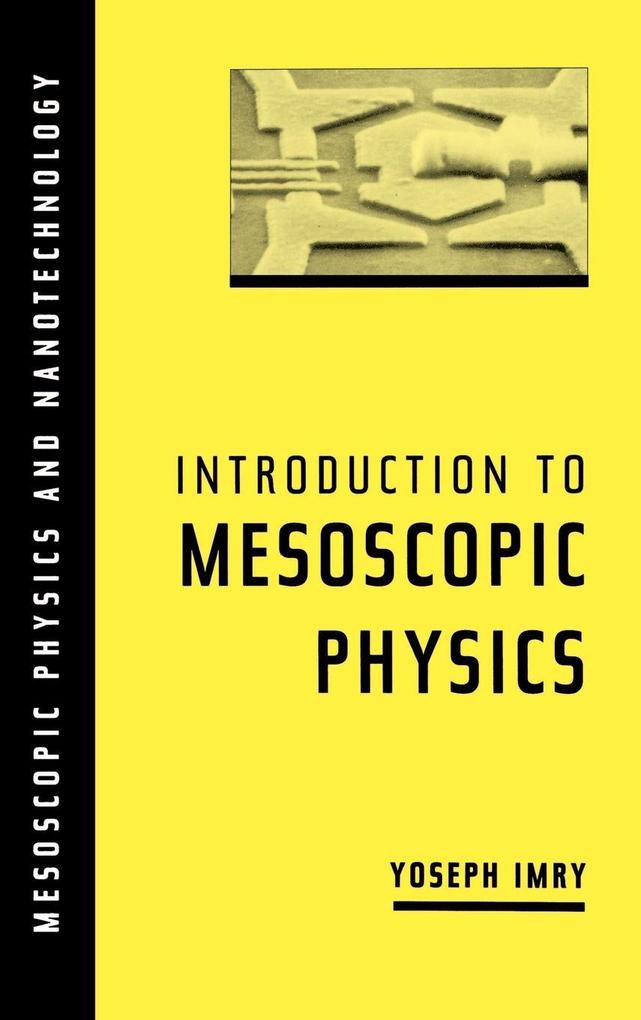
"Mesoscopic physics" refers to the physics of structures larger than a nanometer (one billionth of a meter) but smaller than a micrometer (one millionth of a meter). This size range is the stage on which the exciting new research on submicroscopic and electronic and mechanical devices is being done. This research often crosses the boundary between physics and engineering, since engineering such tiny electronic components (as many as one million transistors can be fitted onto a single chip) requires a firm grasp of quantum physics. Applications for the future may include such wonders as microscopic robot surgeons that will travel through the blood stream to repair clogged arteries; submicroscopic actuators and builders; and supercomputers that fit on the head of a pin.
Inhaltsverzeichnis
- 1: Introduction and a Brief Review of Experimentally Available Systems
- 2: Quantum Transport, Anderson Localization
- 3: Dephasing by Coupling with the Environment, Applications to Coloumb Electron-Electron Interactions in Metals
- 4: Mesoscopic Effects in Equilibrium and Static Proerties
- 5: Quantum Interference Effects in Transport Properties, the Landauer Formulation and Applications
- 6: The Quantum Hall Effect (QHE)
- 7: Mesoscopics with Superconductivity
- 8: Noise in Mesoscopic Systems
- Appendix
- References
- Index