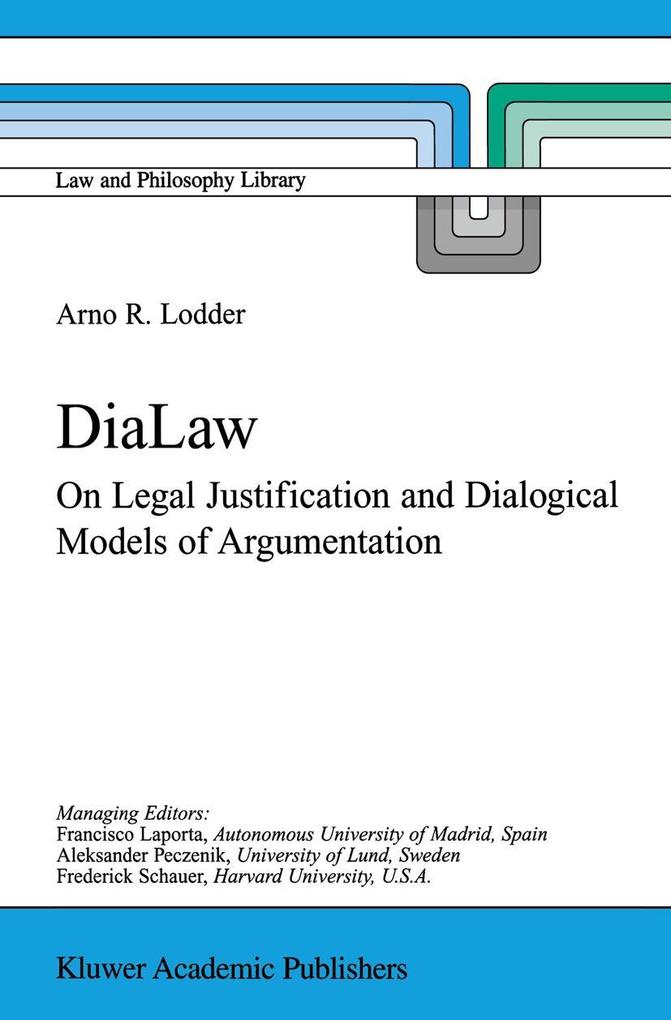
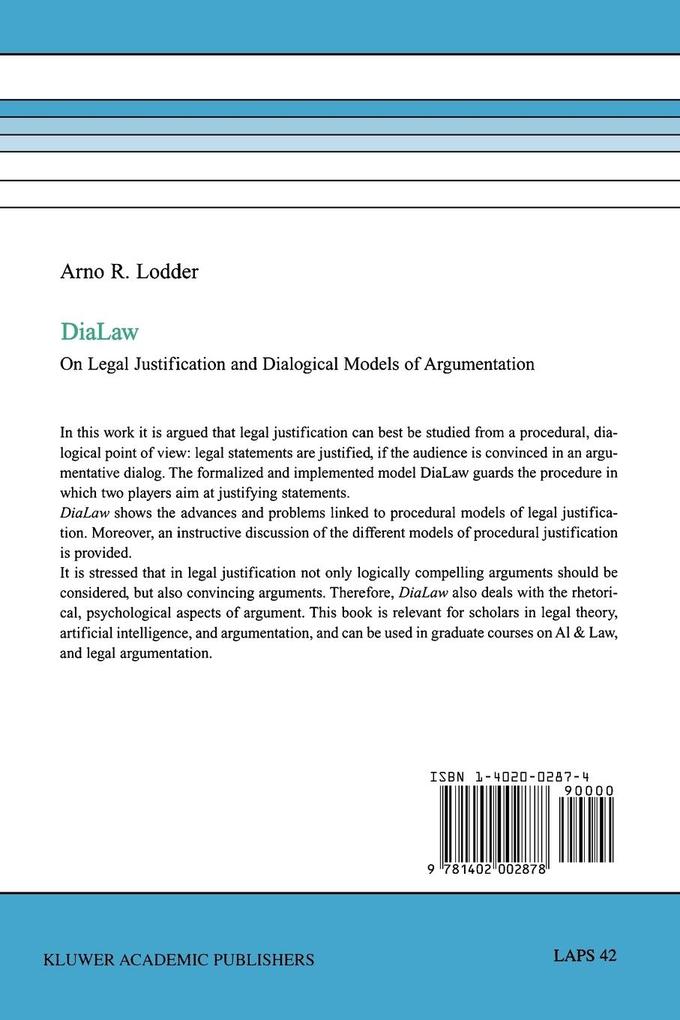
This book is a revised version of my dissertation 'DiaLaw - on legal th justification and dialog games' that I defended on June 5 1998 at the Universiteit Maastricht. The chapters 1, 4 & 5 (now: 1, 5 & 6) of my dissertation have remained largely unaltered. In chapter 2 I added explicitly the distinction between constructing legal justification and reconstructing it, and tried to elucidate the differences (and similarities) between the product and process of justification. Chapter 3 is divided into two chapters: one on the general characteristics of DiaLaw (now: chapter 3), and the other on specific, legal characteristics of DiaLaw (now: chapter 4). In order to improve readability, all rules in these chapters have been rewritten considerably. The section on the implementation of DiaLaw is moved to the appendix. In chapter 7 (the former chapter 6), a discussion of the notions 'procedural' and 'structural' arguments is added, and different layers in argumentation models are discussed. Finally, in chapter 8 (the former chapter 7) is added a recapitulation of my view on legal justification, and a discussion on the future use in legal practice of dialog models that represent argumentation in a natural way. The main thesis has remained unaltered: legal justification should be modeled as a procedural, dialogical model in which not only products of argumentation are allowed, but, even in formal models, rhetorical, psychological aspects of argument are dealt with.
Inhaltsverzeichnis
1 Introduction. - 1. Artificial Intelligence and Law. - 2. Legal justification. - 3. Outline of the book. - 2 From law to DiaLaw Why legal justification should be modeled dialogically. - 1. The product and the process of justification. - 2. Justification as a product. - 3. The defeasible nature of legal justification. - 4. The open nature of law. - 5. The Münchhausen Trilemma. - 6. Justification as a process: a dialogical model. - 7. Dealing with defeasibility, open nature, and the Münchhausen Trilemma in a dialogical model. - 8. Justification of dialog rules and altering protocols. - 9. How pure is the procedure of legal justification? . - 10. Conclusion. - 3 DiaLaw Framework and general rules. - 1. Justification in DiaLaw. - 2. Basic concepts of DiaLaw. - 3. DiaLaw s dialogical framework. - 4. General rules for communication. - 5. Towards legal justification. - 4 DiaLaw Special rules for communication. - 1. Special language elements. - 2. Special rules for communication - legal tools and forced commitment. - 3. Concluding remarks. - 5 DiaLaw in action. - 1. The Tyrell case. - 2. The Chabot case. - 3. Concluding remarks. - 6 Dialogical models of argumentation. - 1. The purpose of models. - 2. A short sample dialog. - 3. Mackenzie s DC and Hamblin s H. - 4. Rescher s Dialectics and the formal elaboration by Brewka. - 5. Gordon s Pleadings Game. - 6. Survey of moves and commitment. - 7. Other related research. - 8. Conclusion. - 7 What is an argument? Properties of procedural models of argumentation. - 1. Argumentation: two perspectives. - 2. Argumentation: two types. - 3. Towards combining the approaches. - 4. DiaLaw: rational and dia-rational argumentation. - 5. Procedural and structural arguments. - 6. Layers in models of legal argumentation. - 7. Conclusion. - 8 In conclusion. - 1. On legaljustification. - 2. The answers. - 3. The future: towards natural dialog models. - 4. Closing remarks. - Appendix- Prolog code of DiaLaw. - References. - Index of names. - Index of subjects.