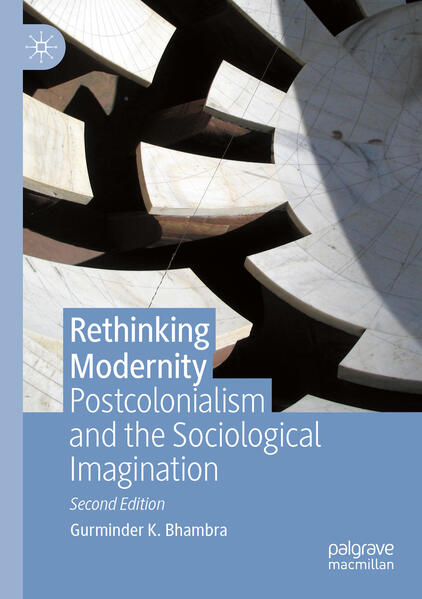
The second edition of this influential book addresses how the experiences and claims of non-European 'others' have been rendered invisible to the standard narratives and analytical frameworks of sociological understandings of modernity. In challenging the dominant, Euro-centred accounts of the emergence and development of modernity, Bhambra puts forward an argument for 'connected histories' in the reconstruction of historical sociology at a global level. This updated version of the original, published in 2007, adds a new preface which explores key themes that Bhambra has further developed over the intervening years: specifically, how the rethinking of modernity enables us to reconstruct sociology and a call for a 'reparatory sociology' committed to the repair of the social sciences and the securing of global justice.
Inhaltsverzeichnis
Introduction: Postcolonialism, Sociology, and the Politics of Knowledge Production. - Part 1: Sociology and its Historiography. - Chapter 1: Modernity, Colonialism, and the Postcolonial Critique. - Chapter 2: European Modernity and the Sociological Imagination. - Chapter 3: From Modernization to Multiple Modernities: Eurocentrism Redux. - Part 2: Deconstructing Eurocentrism: Connected Histories. - Chapter 4: Myths of European Cultural Integrity The Renaissance. - Chapter 5: Myths of the Modern Nation-State The French Revolution. - Chapter 6: Myths of Industrial Capitalism The Industrial Revolution. - Conclusion: Sociology and Social Theory after Postcolonialism Towards a Connected Historiography.