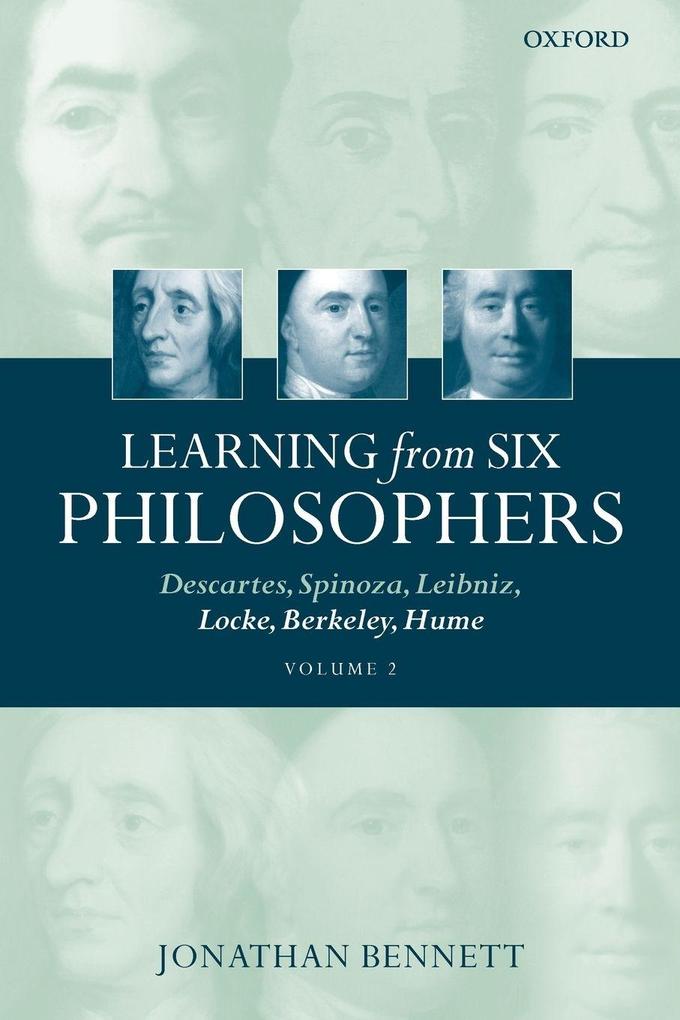
Jonathan Bennett engages with the thought of six great thinkers of the early modern period: Descartes, Spinoza, Leibniz, Locke, Berkeley, and Hume. While not neglecting the historical setting of each, his chief focus is on the words they wrote. What problem is being tackled? How exactly is the solution meant to work? Does it succeed? If not, why not? What can be learned from its success or failure? For newcomers to the early modern scene, this clearly written work is an excellent introduction to it. Those already in the know can learn how to argue with the great philosophers of the past, treating them as colleagues, antagonists, students, teachers. In this second volume, Bennett focuses on the work of Locke, Berkeley, and Hume.
Inhaltsverzeichnis
- Volume 2
- 21: Lockean Ideas: Overview and Foundations
- 22: Lockean Ideas: Some Details
- 23: Knowledge of Necessity
- 24: Descartes's Theory of Modality
- 25: Secondary Qualities
- 26: Locke on Essences
- 27: Substance in Locke
- 28: Berkeley against Materialism
- 29: Berkeley's Use of Locke's Work
- 30: Berkeley on Spirits
- 31: Berkeleian Sensible Things
- 32: Hume's 'Ideas'
- 33: Hume and Belief
- 34: Some Humean Doctrine about Relations
- 35: Hume on Causation: Negative
- 36: Hume on Causation: Positive
- 37: Hume on the Existence of Bodies
- 38: Reason
- 39: Locke on Diachronic Identity-Judgements
- 40: Hume and Leibniz on Personal Identity
- Bibliography, Index of Persons, Index of Topics