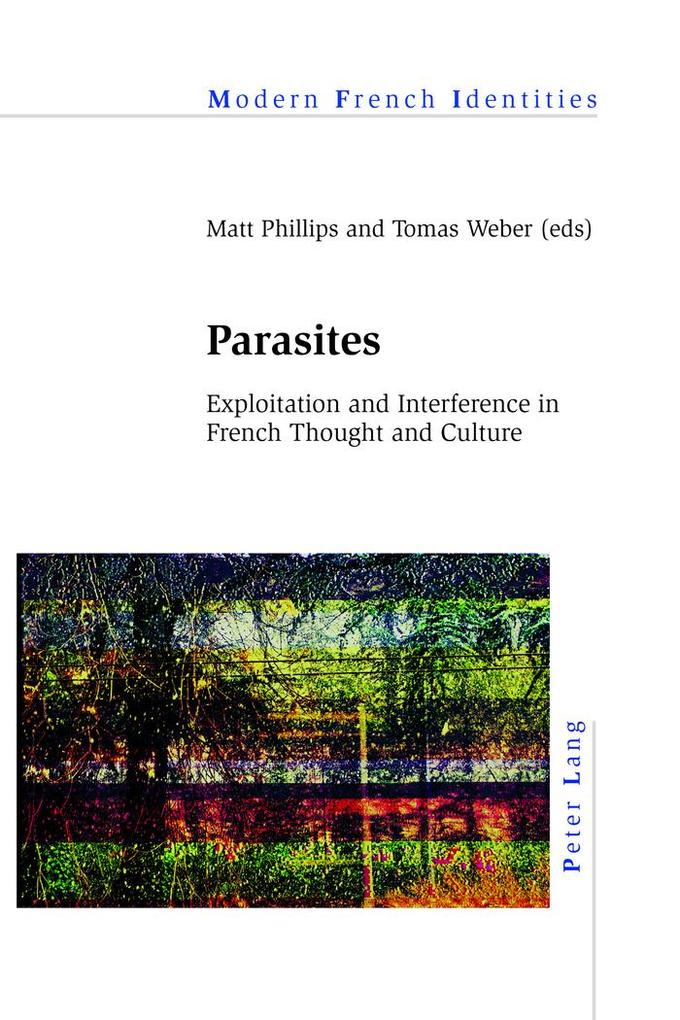
The concept of the parasite - 'one who eats at the table of another' - was mobilized by Michel Serres in 1980 to figure disruptions and breakdowns in society and communication. The chapters of this volume explore the concept in French literature, film, art and philosophy, demonstrating the new and continued relevance of the figure of the parasite.
The word «parasite» evokes nearness and feeding: the Greek parasitos is «one who eats at the table of another». In biology, a parasitic organism is the beneficiary of an unequal relation with its host. The social parasite, too, is one recognized or misrecognized as the unproductive recipient of one-way exchange. In communications theory, meanwhile, static or interference («parasite», in French) is the useless information which clouds the channel between sender and receiver.
In 1980, Michel Serres's Le Parasite mobilized the concept of the parasite to figure noises, disruptions, destructions and breakdowns at the heart of communication systems, social structures and human relations. Drawing on Serres's work, the chapters of this volume - organized around two conceptual poles, exploitation and interference - examine French literature (Villiers de l'Isle Adam, Proust, contemporary poetry), film (Nicolas Philibert, Claus Drexel), art (Sophie Calle, contemporary «glitch art») and philosophy (Descartes, Serres, Derrida, Deleuze and Guattari), alongside medieval hagiography, immunology, communications theory and linguistic anthropology. The volume thereby demonstrates the new and continued relevance of the figure of the parasite in thinking about transmission, attachment, use, abuse and dependency.
Inhaltsverzeichnis
CONTENTS: Steven Connor: Parables of the Para- - Khalil Khalsi: Homelessness and Urban Parasitism: Diagnosing the City's Malaise - Alice Blackhurst: Taking Care or Taking Advantage? Sophie Calle's Prenez soin de vous - Andrew Jones: The Philosophical Commitments of the Self-Metaphor in Immunology - Anne Orset: The Parasitical Relationship between Science and the Sacred in Villiers de l'Isle-Adam's Claire Lenoir and L'Ève Future - Michael Lucey: What You Might Hear When People Talk, or Proust as a Linguistic Anthropologist - Rhiannon Harries: The Parasitic and the Ordinary: Speech, Time and Ethics in Nicolas Philibert's La Maison de la radio - Nicholas Cotton: «Se laisser contaminer»: Parasitic Practices, Paradigms of Deconstruction - Blake Gutt: An Infestation of Signification: Narrative and Visual Parasitism on the Manuscript Page - Carole Nosella: The Parasite A(r)t Work: Digital Glitches in Visual Art - Matt Phillips: Empathic Static: Empathy and Conflict, with Simon Baron-Cohen and Virginie Despentes