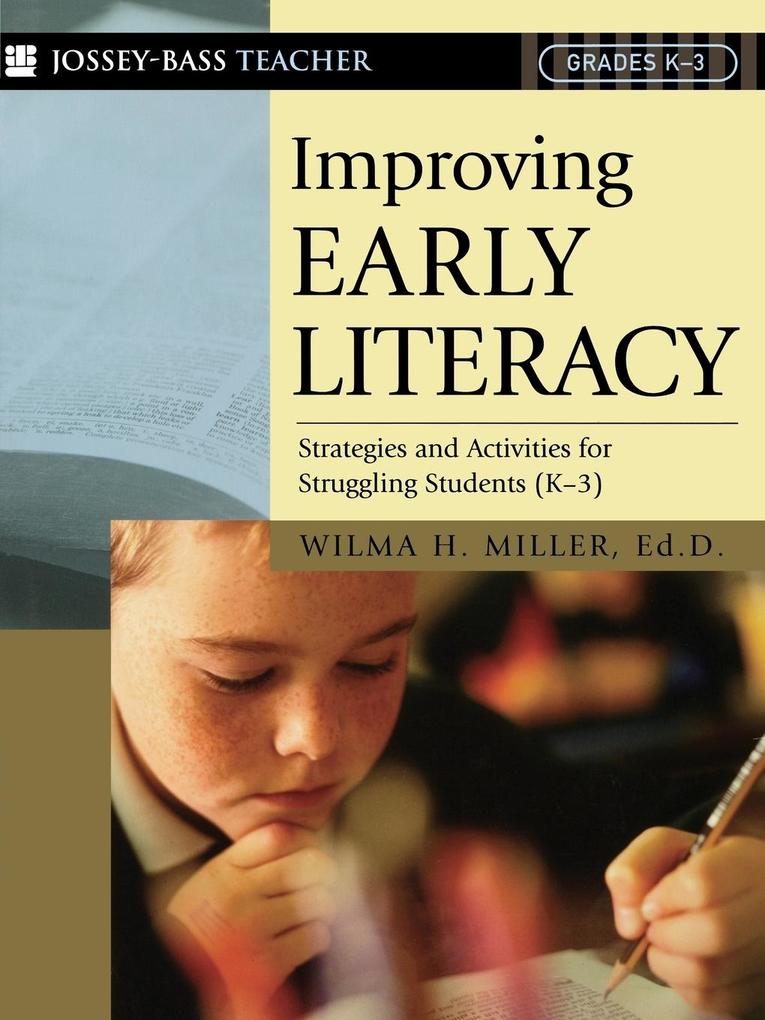
Improving Early Literacy Strategies and Activities for Struggling Students (K-3)
This practical resource provides teachers with creative strategies, games, and reproducible activity sheets that are designed to help improve literacy skills in struggling K-3 readers. Improving Early Literacy addresses five general areas for improving reading instruction: letter-name knowledge, sight word knowledge, phonics, word structure, contextual analysis, vocabulary knowledge, and comprehension. It also includes reproducible informal assessment devices. Written by Wilma H. Miller, an expert in the field of early literacy, this important book is based on solid research and includes activities, strategies, and hands-on exercises that can be used both in standard and in special education classrooms for either whole class instruction or work with individual students.
Improving Early Literacy offers teachers an arsenal of reading strategies for helping struggling emergent readers develop letter-name knowledge, sight word knowledge, phonics, and reading fluency skills. This book provides a comprehensive listing of various strategies incorporated into activities and worksheets and offers
- a practical introduction to early literacy instruction
- informal assessment devices based on proven research concepts
- approaches, strategies, and materials for teaching early literacy skills
- techniques for developing listening and oral language skills
- ways to assess and implement letter-name knowledge and sight word knowledge
- strategies for improving phonic analysis
- enhancement of structural and contextual analysis
- ways to expand vocabulary and comprehension
- techniques for teaching emergent literacy to children with special needs
Inhaltsverzeichnis
Preface vii
Acknowledgments ix
About the Author xi
Chapter 1: A Practical Introduction to Early Literacy 1
A Brief Description of Early Literacy 3
The Rationale for Developing Early Literacy Skills in Early Childhood Programs 10
Whole Language and Its Place in Early Literacy Instruction 10
Whole Language and Children Who Have Special Needs 14
Whole Language and Children Who Have Average Linguistic Skills 16
Whole Language and Children Who Have Above Average Linguistic Skills 20
The Language-Experience Approach (LEA) in Early Literacy Programs 22
The Language-Experience Approach for Children Who Have Special Needs 25
The Language-Experience Approach for Children with Average Linguistic Skills 27
The Language-Experience Approach for Children with Above Average Linguistic Skills 28
Chapter 2: Assessment Devices in Early Literacy Programs 31
Standardized Tests and Their Major Advantages and Limitations 33
Informal Assessment in Early Literacy Programs 35
Checklist of Primary-Grade Writing Behaviors 104
Chapter 3: Listening and Oral Language Skills 107
Listening 109
Oral Language 114
Theories of Oral Language Development 114
Stages of Oral Language Development 117
Chapter 4: Letter-Name and Sight-Word Knowledge 125
Letter-Name Recognition and Identification 127
Sight-Word Recognition and Identification 153
Chapter 5: Improving Competency in Phonics 173
Phonemic Awareness 175
Phonics 175
The Most Common Phonic Elements 177
Chapter 6: Improving Ability in Word Structure and Context 199
Word Structure 201
Context Clues 217
Chapter 7: Improving Ability in Vocabulary and Comprehension 231
Types of Meaning Vocabularies and Their Relation to Reading Achievement 233
Reading Comprehension 242
Appendix I: Big Book Resources 269
Appendix II: Predictable Books 271
Appendix III: Recommended LEA Resources 275
Appendix IV: For Additional Reading 277
Appendix V: Chants, Finger Plays, Action Verses, and Recommended Books 279
Appendix VI: Wordless Books 287
Appendix VII: The Dolch Basic Sight Words 289
Appendix VIII: Books for Reviewing Individual Letter Names 293
Appendix IX: Cooking and Baking Activities to Review Letter Names 299
Appendix X: Contemporary Easy-to-Read Trade Books 303
Appendix XI: Further Reading on Phonics 305
Appendix XII: Trade Books for Improving Phonic Skills in Context 307
Appendix XIII: Books to Promote Enjoyment of Words 313
Appendix XIV: Poetry Books for Young Children 315
Appendix XV: Books for Visual Imagery 317
Bibliography 319
Answer Key 327