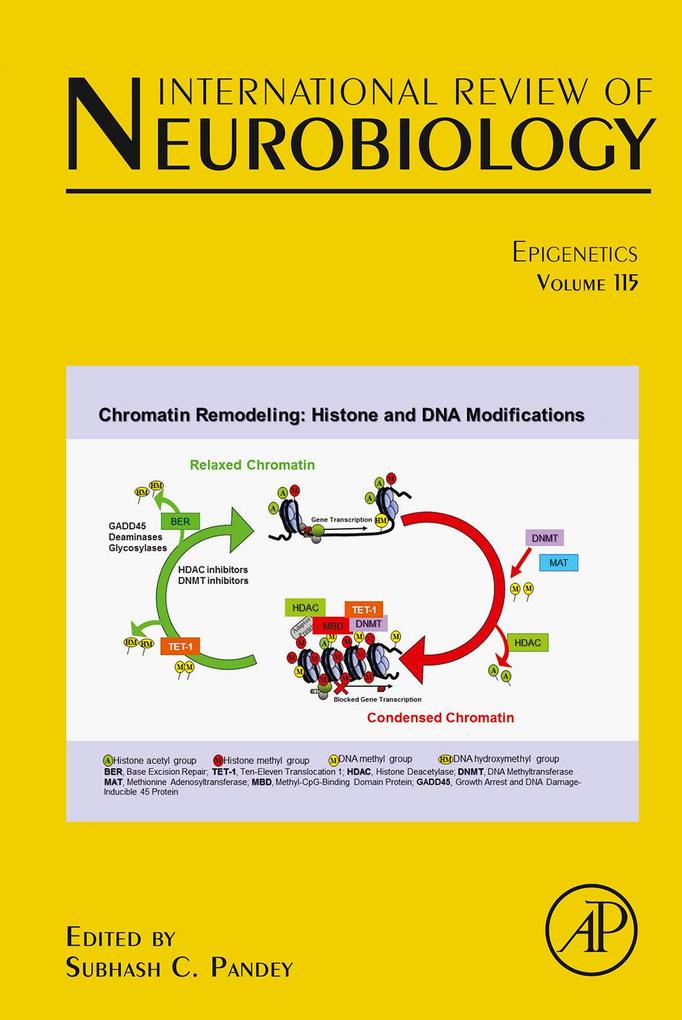
This well-established international series examines major areas of basic and clinical research within neuroscience, as well as emerging and promising subfields. This volume concentrates on Epigenetics
- This book looks at Epigeneticsin the light of the newest scholarly discoveries and insights
Inhaltsverzeichnis
1;Front Cover;1 2;Epigenetics;4 3;Copyright;5 4;Contents;6 5;Contributors;10 6;Preface;12 7;Chapter One: Environmental Alterations of Epigenetics Prior to the Birth;16 7.1;1. Introduction;17 7.2;2. Manifestation of Environmental Factors;19 7.2.1;2.1. Substances of abuse;19 7.2.1.1;2.1.1. Drinking;19 7.2.1.2;2.1.2. Smoking;25 7.2.1.3;2.1.3. Cocaine;25 7.2.1.4;2.1.4. Cannabis;26 7.2.1.5;2.1.5. Opioid;27 7.2.1.6;2.1.6. Methamphetamine;27 7.2.2;2.2. Diet and nutrition;28 7.2.2.1;2.2.1. Folic acid;28 7.2.2.2;2.2.2. Caffeine;29 7.2.3;2.3. Prescriptive medicine;29 7.2.3.1;2.3.1. Valproic acid;29 7.2.3.2;2.3.2. .-Hydroxybutyrate;30 7.2.4;2.4. Environmental toxins and pollutants;30 7.2.4.1;2.4.1. Arsenic;30 7.2.4.2;2.4.2. Lead;31 7.2.4.3;2.4.3. Cadmium;31 7.2.4.4;2.4.4. Methyl mercury;31 7.2.4.5;2.4.5. Bisphenol A;32 7.2.5;2.5. Stress and aversive life experience;33 7.3;3. Mechanisms of Environmentally Induced Epigenetic Changes;34 7.3.1;3.1. On DNA methylation;34 7.3.2;3.2. On histone modification;38 7.3.3;3.3. On miRNA and other noncoding RNA;38 7.3.4;3.4. On transposable elements;39 7.4;4. Effect of Epigenetic Alterations on Neurodevelopment;40 7.4.1;4.1. Epigenetic functional concerns;40 7.4.2;4.2. Intrinsic epigenetic program;41 7.4.3;4.3. Alcohol drinking, epigenetics phenotypes, and FASDs;45 7.4.3.1;4.3.1. Effect on germline and placenta;46 7.4.3.2;4.3.2. Effect on embryonic and early brain development;46 7.4.3.3;4.3.3. Potential late-onset effect;47 7.4.3.4;4.3.4. Transgenerational effect;48 7.5;Acknowledgments;49 7.6;References;49 8;Chapter Two: Transgenerational Epigenetics and Brain Disorders;66 8.1;1. Introduction to Transgenerational Epigenetic Inheritance;66 8.2;2. Epigenetics and Epigenetic Processes;68 8.3;3. Evidence for Transgenerational Epigenetic Inheritance;70 8.4;4. Germline-Independent Epigenetic Inheritance;72 8.5;5. Germline-Dependent Epigenetic Transmission;72 8.6;6. Transgenerational Epigenetic Effects on Brain Disorders;75 8.7;7. Concluding Remark
s;81 8.8;Acknowledgment;81 8.9;References;82 9;Chapter Three: The Epigenetic Landscape of Alcoholism;90 9.1;1. Introduction;91 9.2;2. Epigenetic Regulation due to Histone Covalent Modifications;93 9.2.1;2.1. Role of histone acetylation and deacetylation in transcriptional regulation;93 9.2.2;2.2. Alcohol and histone acetylation and deacetylation mechanisms in the brain;96 9.2.3;2.3. Role of HDACs in alcoholism;97 9.2.4;2.4. Alcohol and histone acetylation and deacetylation mechanisms in nonneuronal tissues;100 9.2.5;2.5. Other drugs of abuse and histone acetylation and deacetylation mechanisms;101 9.2.6;2.6. Alcohol and histone methylation mechanisms;102 9.2.7;2.7. Alcohol and histone phosphorylation mechanisms;103 9.3;3. Epigenetic Regulation due to DNA Methylation;104 9.3.1;3.1. Functions of DNMTs and MBDs;105 9.3.2;3.2. DNA demethylation pathways in the brain;106 9.3.3;3.3. Alcohol and DNA methylation and demethylation mechanisms;106 9.3.4;3.4. Alcohol and DNA methylation mechanisms in nonneuronal tissues;108 9.3.5;3.5. Other drugs of abuse and DNA methylation mechanisms;108 9.3.6;3.6. DNMT inhibitors as a therapy for drug addiction;109 9.3.7;3.7. Epigenetics of adolescent drinking and implications for alcohol phenotypes in later life;111 9.3.8;3.8. Epigenetic regulation of glial-neuronal interactions and alcohol;112 9.4;4. Genome-Wide Approaches to Understand the Basis of Alcoholism;113 9.5;5. Using Invertebrate Models to Study the Basis of Ethanol Phenotypes;114 9.6;6. Inheritance of a Drug Phenotype;115 9.7;7. Conclusions;116 9.8;Acknowledgments;118 9.9;References;119 10;Chapter Four: Epigenetic Regulatory Mechanisms in Stress-Induced Behavior;132 10.1;1. Introduction;133 10.2;2. Stress-Induced Neural and Behavioral changes in Adulthood and the Epigenetic Mechanisms Involved;134 10.2.1;2.1. Histone lysine acetylation and deacetylation in stress-induced neural and behavioral responses;135 10.2.1.1;2.1.1. Histone acetyl transferases;135 10.2.1.2;2.1.2. Histone d
eacetylases;136 10.2.2;2.2. Histone lysine acetylation and deacetylation in stress responses;136 10.2.2.1;2.2.1. HDACi as potential therapeutics for psychiatric and neurodegenerative disorders;142 10.2.3;2.3. Histone lysine methylation and demethylation in stress-induced neural and behavioral responses;143 10.2.3.1;2.3.1. Histone lysine methyltransferases and demethylases;143 10.2.3.2;2.3.2. Histone methylation in neuropsychiatric disorders;144 10.2.3.3;2.3.3. Histone lysine methylation in stress-mediated effects on the hippocampal neurogenesis;150 10.2.3.4;2.3.4. KMTs and KDMs as potential drug targets;151 10.3;3. DNA Methylation and Demethylation in Stress-Induced Neural and Behavioral Responses;153 10.4;4. Role of Noncoding RNAs in Epigenetic Regulation of Stress-Mediated Effects;154 10.5;5. Early-Life Stress-Induced Adult Onset Behavioral Disorders and the Epigenetic Mechanisms Involved;159 10.5.1;5.1. Histone lysine acetylation/deacetylation, methylation/demethylation, and DNA methylation in stress-induced neural an...;159 10.6;6. Conclusion;161 10.7;Acknowledgments;162 10.8;References;162 11;Chapter Five: Epigenetics of Schizophrenia: An Open and Shut Case;170 11.1;1. Introduction;171 11.2;2. An Epigenetics Primer;172 11.3;3. Heterochromatization;172 11.3.1;3.1. DNA methylation;172 11.3.2;3.2. Restrictive histone modifications;175 11.3.3;3.3. The heterochromatization positive feedback loop;176 11.4;4. Euchromatization;176 11.4.1;4.1. Relaxing histone modifications;177 11.4.2;4.2. DNA demethylation;177 11.5;5. Schizophrenia and Epigenetics;182 11.5.1;5.1. Restrictive chromatin and schizophrenia;182 11.5.2;5.2. Permissive chromatin and schizophrenia;189 11.5.3;5.3. Dysregulated chromatin and schizophrenia;191 11.6;6. Fulfilling the Promise of Epigenetics in Schizophrenia;193 11.6.1;6.1. Therapeutics: Targeting the epigenome;193 11.6.2;6.2. How do current antipsychotics affect the epigenome?;193 11.6.3;6.3. Relaxing the epigenome;194 11.6.4;6.4. Silencing the epi
genome;196 11.6.5;6.5. Blood cells to monitor disease course and individualize treatment;197 11.7;7. Conclusion;199 11.8;Acknowledgments;199 11.9;References;199 11.10;Further Reading;216 12;Chapter Six: Epigenetic Mechanisms in Autism Spectrum Disorder;218 12.1;1. Introduction;219 12.2;2. Molecular Aspects of Epigenetic Mechanisms;221 12.2.1;2.1. Histones;221 12.2.2;2.2. DNA methylation;224 12.2.3;2.3. DNA hydroxymethylation;227 12.3;3. Genetic Defects with Epigenetic Implications;228 12.3.1;3.1. Methyl-CpG-binding protein 2 (MECP2);229 12.3.2;3.2. DNA topoisomerase;231 12.3.3;3.3. Chromodomain helicase DNA-binding protein 8;232 12.4;4. Epigenetic Dysregulation of ASD Candidate Genes;233 12.4.1;4.1. GABAergic genes;233 12.4.2;4.2. GAD67 (GAD1);234 12.4.3;4.3. Reelin;235 12.4.4;4.4. GABA ß3;237 12.4.5;4.5. Oxytocin receptor (OXTR);238 12.4.6;4.6. Brain-derived neutrophic factor (BDNF);238 12.4.7;4.7. Ubiquitin-protein ligase E3A (UBE3A);239 12.4.8;4.8. Engrailed-2 (EN-2);240 12.4.9;4.9. SH3 and multiple ankyrin repeat domains (SHANK3);241 12.5;5. Environmental Model of Autism;242 12.6;6. Conclusions;244 12.7;Acknowledgments;246 12.8;References;246 13;Chapter Seven: MicroRNAs and Ethanol Toxicity;260 13.1;1. Introduction;261 13.2;2. miRNAs and Their Biogenesis;262 13.2.1;2.1. Biogenesis of miRNAs;264 13.3;3. Mechanisms of miRNA Function;267 13.3.1;3.1. Targeting 3'UTRs for mRNA degradation and translation repression;267 13.3.2;3.2. Alternate functions of miRNAs;268 13.3.2.1;3.2.1. Transcription control and regulation of heterochromatin;269 13.3.2.2;3.2.2. Secreted miRNAs: Potential endocrine and signaling molecules?;271 13.4;4. miRNAs as Mediators of Ethanol Effects in Developing and Adult Tissues;273 13.4.1;4.1. miR-9: An example of a common developmental and adult ethanol target;277 13.4.1.1;4.1.1. Developmental effects of ethanol on miR-9;280 13.4.1.2;4.1.2. miR-9 as an adult target of ethanol;281 13.4.2;4.2. Ethanol and epigenetic control over miRNA expression;282
13.4.2.1;4.2.1. The miR-9 genes are an example of an epigenetically regulated miRNA family;283 13.4.2.2;4.2.2. Evidence for epigenetic regulation of miR-9 in tumor biology;284 13.4.2.3;4.2.3. A role for ethanol in epigenetic regulation of miR-9;284 13.4.3;4.3. Ethanol-sensitive miRNAs as mediators of epigenetic control;285 13.5;5. miRNA-Mediated Transgenerational Inheritance of Information: A Novel Mechanism for Transgenerational Transfer of Epimut ...;286 13.6;6. Conclusions;288 13.7;Acknowledgments;290 13.8;References;290 14;Index;300 15;Contents of Recent Volumes;306