Bücher versandkostenfrei*100 Tage RückgaberechtAbholung in über 100 Filialen
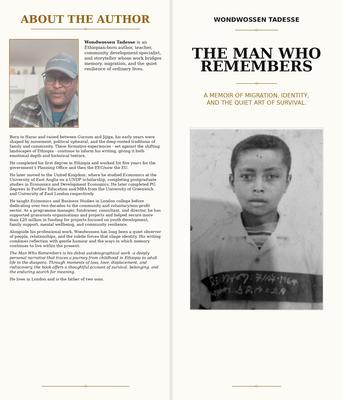
The Man Who Remembers is a literary memoir that traces the life of an Ethiopian boy shaped by war, displacement, silence, and endurance, and the man he becomes across continents. Told through the dual lens of a child's immediacy and an adult's reflection, the book explores how private lives are formed under public upheaval-and how survival often depends not on defiance, but restraint.
Born in the historic walled city of Harar, Wondu's early childhood unfolds across Ethiopia's eastern towns-Gursum, then Jijiga-places marked by movement, fragile belonging, and political tension. His father, a police officer, embodies duty and quiet pride; his mother, Yenenesh, becomes the family's true engine of survival-trading, adapting, protecting. Jijiga, a dusty frontier town near the Somali border, forms the emotional core of the narrative: a place of schoolyard cruelty, friendship warped by envy, early responsibility, and a family shop that becomes Wondu's refuge and classroom.
As Ethiopia enters one of its most turbulent periods-the 1977-78 Ethio-Somali War, the Red Terror, and later the 1984 famine-Wondu is repeatedly displaced. He witnesses violence, arbitrary power, and moral contradiction at close range. During the government's forced Resettlement Campaign, he is sent as a university student to the disease-ridden lowlands near the Sudanese border, where idealism collapses under heat, illness, and unintended harm. These experiences teach him a defining lesson: visibility is dangerous; silence can be ethical.
Education becomes his way through. At Addis Ababa University, Wondu studies Economics while navigating surveillance, political suspicion, and quiet intimidation. Unlike louder peers, he survives by choosing distance-academically excelling without attracting attention. Friendship finally becomes safe through a small circle built on trust rather than competition. His graduation leads to work in Ethiopia's Ministry of Planning, then with the EEC (Now the European Community), where he begins to understand development not as ideology, but practice.
Two years after graduation, his father dies. The loss-handled through Ethiopian mourning rituals, communal grief, and silence-marks a turning point. Shortly after, a UNDP scholarship takes Wondu to England. In Norwich, and later London, he must learn again how to be alone-this time without fear. Work in education and the NGO sector follows, alongside relationships that falter before maturity arrives.
Fatherhood becomes the final anchoring force. Through his two sons, Wondu comes to understand pride, responsibility, and love in ways his own life had delayed but prepared him for.
The book closes where it begins: at sixty, in a London kitchen, with memory no longer urgent but generous.
Es wurden noch keine Bewertungen abgegeben. Schreiben Sie die erste Bewertung zu "The Man who Remembers" und helfen Sie damit anderen bei der Kaufentscheidung.