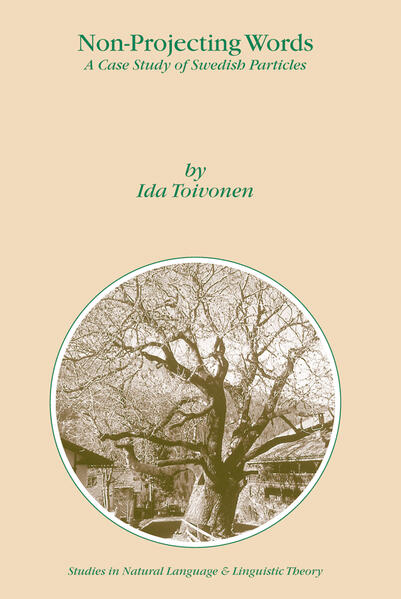
Focusing primarily on Swedish, a Germanic language whose particles have not previously been studied extensively, Non-Projecting Words: A Case Study on Swedish Particles develops a theory of non-projecting words in which particles are morphologically independent words that do not project phrases.
Particles have long constituted a puzzle for Germanic syntax, as they exhibit properties of both morphological and syntactic constructs. Although non-projecting words have appeared in the literature before, it has gone largely unnoticed that such structures violate the basic tenets of X-bar theory. This work identifies these violations and develops a formally explicit revision of X-bar theory that can accommodate the requisite "weak" projections.
The resulting theory, stated in terms of Lexical-Functional Grammar, also yields a novel classification of clitics, and it sheds new light on a range of recent theoretical proposals, including economy, multi-word constructions, and the primitives of lexical semantics. At an abstract level, we see that the modular, parallel-projection architecture of LFG is essential to the description of a variety of otherwise recalcitrant facts about non-projecting words.
Inhaltsverzeichnis
1. Introduction. - 1. Particles And X -Theory. - 2. Swedish Clause Structure. - 3. Overview. - 2. Empirical Motivation. - 1. Particles As Non-Projecting Words. - 2. Arguments Against An XP Analysis. - 3. Arguments Against A Morphological Analysis. - 4. Particles and Clitics. - 5. Summary. - 3. Phrase Structure. - 1. Introduction. - 2. X -Structure. - 3. X -Principles. - 4. C-Structure To F-Structure Mappings. - 5. Linear Order. - 6. Economy of Expression. - 7. Summary of The C-Structure Theory. - 9. Conclusion. - 4. Verbal Particles In The Swedish VP. - 1. The C-Structure. . - 2. The Structure-Function Mapping. - 3. Head-Adjunction. - 4. Recursion. - 5. Economy And Swedish Particles. - 6. Word Order: Apparent Problems. - 7. Summary. - 5. The Meaning of Swedish Particles. - 1. Resultsative Particles. - 2. Aspectual Particles. - 3. Idiomatic Verb-Particle Combinations. - 4. Summary. - 6. Other Germanic Languages. - 1. Danish. - 2. German. - 3. English. - 4. The Complex Particle Construction. - 5. An Overview of Germanic Particles. - 7. Conclusion. - 1. X -Theory. - 2. Economy Of Expression. - 3. The Structure-Function Mapping. - 4. Resultative Predication. - 5. Clitics. - 6. Summary. - Appendix A. Economy of Expression. - 1. The Economy Principle. - 2. Economy and Swedish Clause Structure. - 2. 1. Object shift. - 2. 2. V2 and Economy. - References. - Index Of Names. - Index Of Subjects.