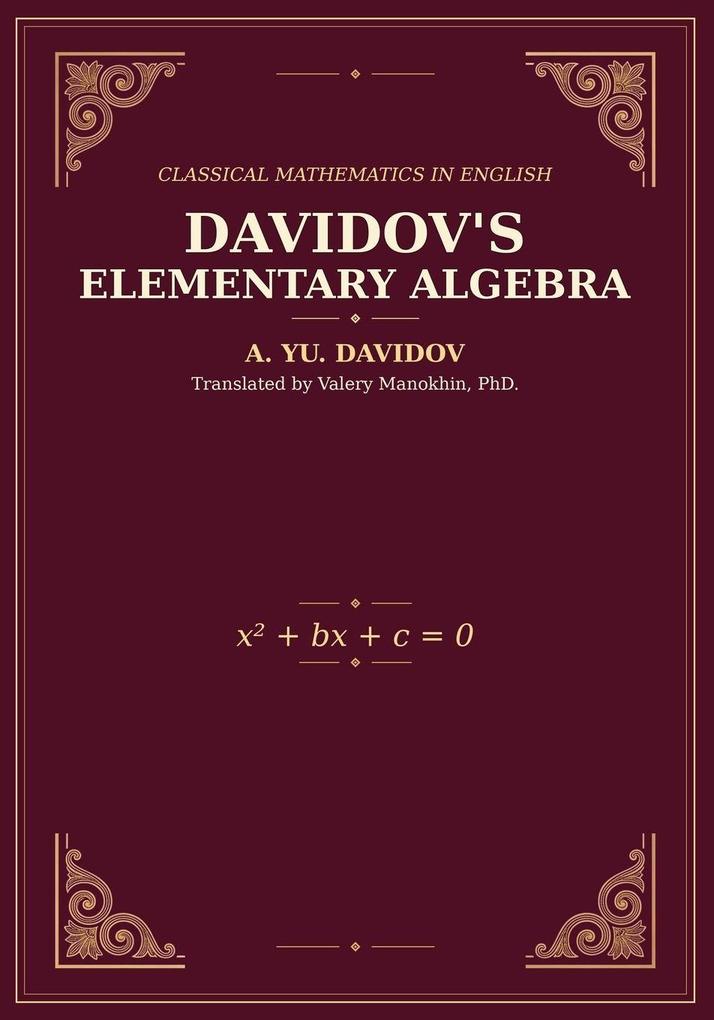
The man who wrote this algebra founded the Moscow Mathematical Society and presided over it
for the last twenty years of his life.
August Yulievich Davidov (1823-1885) was professor of mathematics at the Imperial Moscow
University and, for twelve years, head of its Faculty of Physics and Mathematics. In 1866,
with N. D. Brashman, he founded the Moscow Mathematical Society and became its first
president, holding that office until his death. In the middle of that career he wrote a
course of algebra for secondary schools. It went through twenty-four editions over the
following half-century. This book is in English for the first time.
What makes Davidov's Elementary Algebra different from a modern algebra textbook:
Elementary means complete, not simplified. The five divisions run from algebraic signs and
the fundamental operations through polynomials, the greatest common divisor, algebraic
fractions, continued fractions, ratio and proportion, equations of the first degree in one,
two and several unknowns, powers and roots, irrational and incommensurable quantities,
permutations and combinations, Newton's binomial, quadratic equations and their
investigation, the trinomial, imaginary quantities, equations of the third and fourth
degree, inequalities, indeterminate equations, arithmetical and geometrical progressions,
infinite series, logarithms, and compound interest. A modern Algebra I and Algebra II
together stop well short of the halfway mark.
It builds the logarithm tables before it uses them. A full chapter is given to the
construction and use of ordinary logarithmic tables, with the tables themselves reproduced.
Students learn where the mantissas come from, then compute with them - a chain of reasoning
that vanished from school mathematics when the tables did.
It treats indeterminate equations and imaginary quantities as school material. Diophantine
problems in integers, and arithmetic on quantities that have no place on the number line,
are both developed here for readers who have not yet left secondary school.
The algebra is carried through to annuities. The final chapter computes compound interest
and periodic payments - the course ends in the working actuarial mathematics of its century,
not in an exercise set.
Every procedure is argued before it is used. The book is built as 478 numbered articles,
cross-referenced throughout. Definitions lead to operations, operations to equations, and
equations to the problems that need them. Davidov defines his terms, gives the reason for
each rule, works the examples, and only then turns the reader loose on the exercises.
509 pages. Five divisions. 39 chapters. 478 numbered articles, with exercises throughout and
a closing division of worked solutions.
This is a faithful translation from the Russian - no adaptation, no modernisation of the
mathematics. The division and chapter order, the numbered articles, the worked examples and
the problem sequences follow the source edition. Where the source misprints something that
its own mathematics contradicts, the correction is made and a translator's note records what
was printed and why it was changed; notation that is merely older than ours is left standing.
Ideal for: students working through a full classical algebra course, homeschool families who
want reasoning rather than procedures, teachers looking for proof-based treatments of school
algebra, competition students meeting Diophantine equations and the binomial theorem for the
first time, historians of mathematics education, and adults rebuilding their mathematics from
the foundations.
Translated by Valery Manokhin, PhD. Published by Northern Star Academic Press. Full catalogue
at russianmathbooks.com.