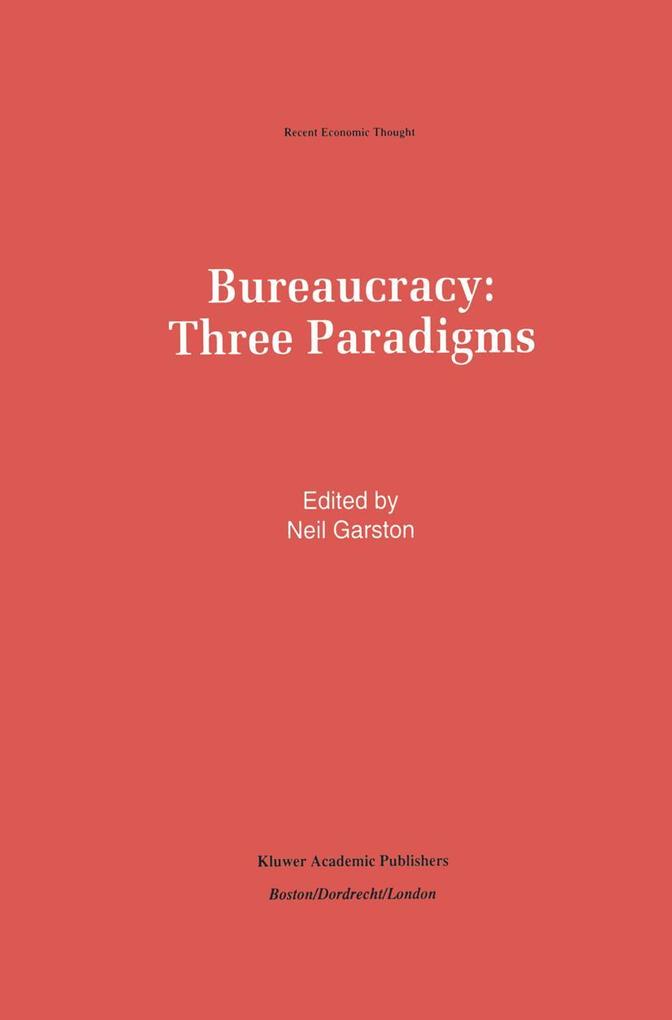
The study of bureaucracy must include certain key questions: what are bureaucrats and bureaucracies; why do they exist and what are their functions; how do they behave; how much power do they possess; what is their impact on efficiency and production; and how do they affect society?
This book contains analyses of all these issues, done by a variety of economists of differing backgrounds, approaches and opinions, broadly categorized under the labels Neoclassical, Institutionalist, and Marxist, although there are overlaps and correspondences that cross ideological and/or paradigmal boundaries.
In this book the labels are employed as a guide to the reader with a preference for one approach over the others, and as an indication of how chapters in different sections are related in their approaches.
Inhaltsverzeichnis
1 The Study of Bureaucracy. - Defining Bureaucracy. - The History of Bureaucracy. - Methodologies/Paradigms. - Current Problems and the Extent of Bureaucracy. - I: The Nature of Bureaucracy. - 2 The Behavior of Corporate Bureaucrats. - 3 Bureaucracy and Class Marxism. - 4 The Emergence and Functions of Managerial and Clerical Personnel in Marx s Capital. - 5 An Institutionalist Theory of Bureaucracy: Organizations and Technology. - II: The Internal Functioning of Bureaucracy. - 6 A Model of Corporate Organizational Structure. - 7 Public Sector Bureaucracy: The Neoclassical Structure. - 8 Bureaucracy/Technocracy, Market Structure and Behavior: An Institutionalist s View. - III: Bureaucracy and Society. - 9 The Economic Functions of Clerical and Managerial Personnel: A Historical Perspective. - 10 Bureaucracy and Society: An Institutionalist Perspective. - 11 Communist Bureaucrats and the Transition to the Market Economy. - 12 Paradigms, Insights, and Problems.