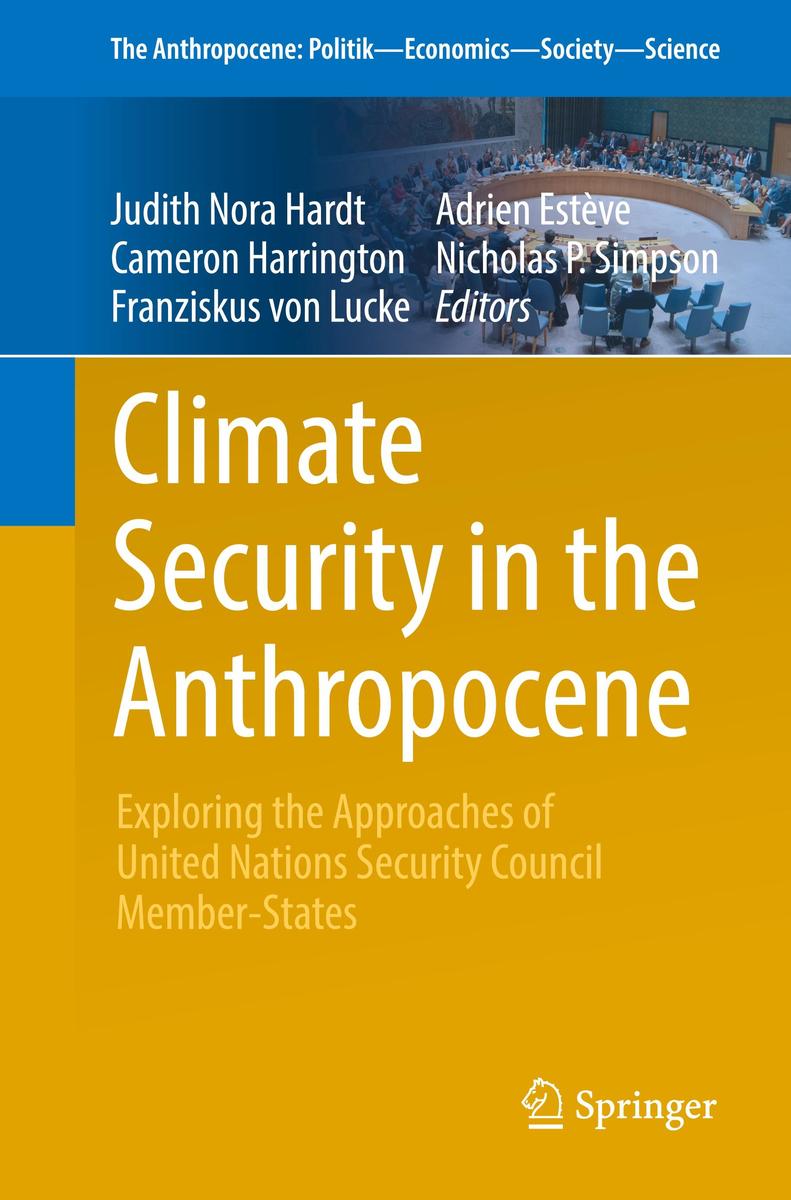
The speed and scale of climate change presents unique and potentially monumental security implications for individuals, future generations, international institutions and states. Long-dominant security paradigms and policies may no longer be appropriate for dealing with these new security risks of the Anthropocene. In response to this phenomenon, this book investigates how states have reacted to these new challenges and how their different understandings of the climate-security nexus might shape global actions on climate change. It focuses on the perceptions, framings, and policies of climate security by members of the United Nations Security Council (UNSC), the world's highest ranking multilateral security forum.
Empirically, the book presents detailed, bottom-up case studies from local authors of every UNSC member state in 2020. It combines this with an innovative theoretical approach spanning national, human and ecological security that helps to capture the complex dynamics of state-led approaches to dealing with security in the Anthropocene. This book therefore offers readers a compelling picture of climate-security politics in the UNSC, beyond Council debates and resolutions. By comparing and contrasting how different framings of climate security impact various policy sectors of members states, the authors are able to assess the barriers and opportunities for addressing climate security locally and globally.
"This timely contribution to the literature on climate security examines the under-analysed relationship between the policy approaches of key countries at the national, and at the international level. Policy alignment at multiple levels of governance will be critical if we are to respond adequately to the ubiquitous challenges posed by climate change and variability." Shirley Scott,Head of School and Professor, School of Humanities and Social Sciences, UNSW Canberra at the Australian Defence Force Academy (Australia).
"Climate change is increasingly considered a problem of 'security', yet what that means remains deeply contested. Behind the rhetoric of 'climate crisis', threats and 'emergencies', UN Security Council members offer profoundly different ideas about what climate change - and security - mean, and what should be done about it. This book brilliantly lays out the hidden or overlooked divergences of interests and perspectives on 'climate security' that are playing out in the world's most central security institution, as it grapples with securing a climate unstable world."
Olaf Corry, Professor of Global Security Challenges, Faculty of Social Sciences, School of Politics and International Studies, University of Leeds (United Kingdom).
"Security is a contested concept, whose scope and direction are subject to change. The prime value of this volume is the systematic documentation of the dynamics in defining what security is about in reaction to ever dramatic climate change. The book's focus on a somewhat representative sample of states - the members of the Security Council - provides robust evidence that even though many governments remain reluctant to retreat from traditional perceptions of security, there is a large and growing acceptance of the need to adjust priorities in providing security in response to climate change and its consequences."
Michael Brzoska, Professor and Senior Research Fellow, IFSH Institute for Peace Research and Security Policy, Universität Hamburg (Germany).
"The climate security literature has often been labelled as West-centric with little recognition of knowledge production processes, and different historical, socio-economic, and political experiences ofvarious societies in the Global So
Inhaltsverzeichnis
1.Introduction: A Framework for Assessing Climate Security.- 2.The Rise of Belgium as a Multilateral Climate-Security Actor: Analysis of Evolving Climate and Security Policies (2009-2021).- 3.Climate Security in China: An Issue for Humanity Rather than the Nation.- 4.Dominican Republic: Security Perspective from Disaster Risk Management and Climate Change Policies.- 5.Securitisation of Climate Change in Estonia: Widening Security Concepts in National Strategies and Foreign Policy Activities.- 6.Preventing and Managing Climate Risks: France's Approach to Climate Security.- 7.Climate Security Discourses in Germany: The Transformation of Climate Change towards a Development and Foreign Policy Priority.- 8.The Climate-Security Nexus in Indonesia: A Multitude of Threats and Approaches.- 9.Conception, Perception, and Approach to Climate Security in Niger.- 10.Climate Change in Security Perceptions and Practices in Russia.- 11.Securing a Climate-Resilient Pathway for South Africa.- 12.Climate Security and Global Climate Injustice: The Case of St. Vincent and the Grenadines.- 13.Climate Security Perceptions in Tunisia: Food Security as a Dominant Paradigm.- 14.Climate Change as a 'Threat Multiplier': The Construction of Climate Security by the United Kingdom - 2007-2020.- 15.Climate Security at the UN and in the United States, 2007-2020: The Contradictory Leadership and Silence of the US.- 16.The Climate-Security Nexus in Vietnam: Effect on the Pathway to Sustainable Development.-17.Climate Security at a Crossroads: The Evolution and Future of Climate Security in the United Nations Security Council and its Member States.