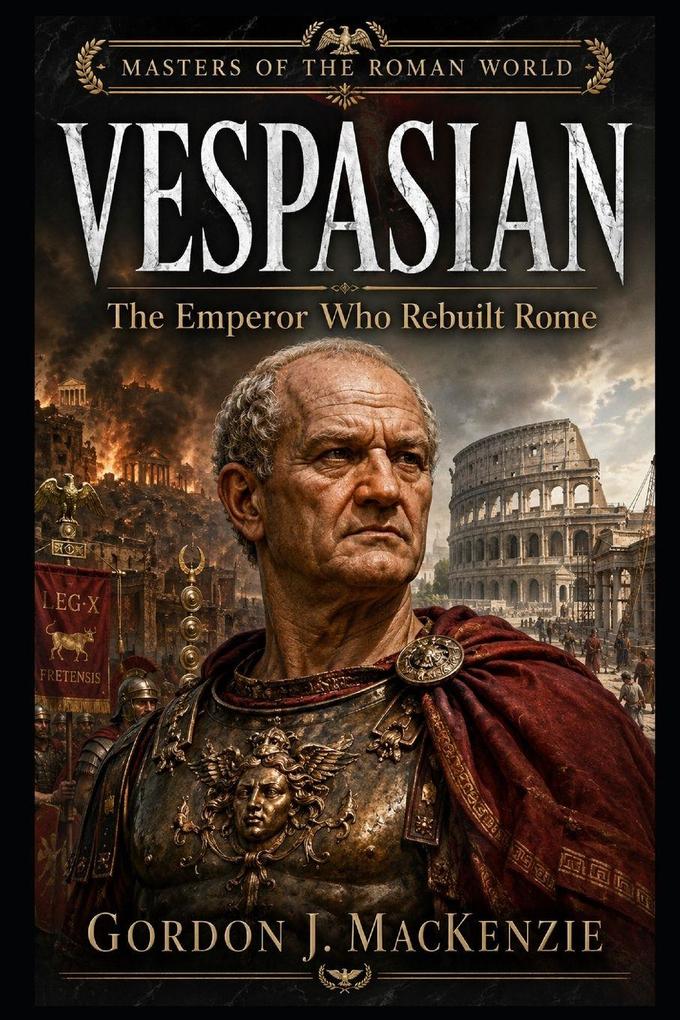
Vespasian did not look like the man Rome had been waiting for. He was not born into the old imperial glamour of the Julio-Claudians, nor did he possess the theatrical brilliance of Nero. He was practical, blunt, experienced, financially severe and unromantic.
That was exactly what Rome needed.
After Nero's fall, the Roman world descended into the chaos of AD 69, the Year of Four Emperors. Galba, Otho and Vitellius each tried to claim the centre of power, but none could make the empire stable. Armies made and unmade rulers. Rome itself became a battlefield. The imperial office had lost its inherited certainty.
Then came Vespasian.
Vespasian: The Emperor Who Rebuilt Rome tells the story of the unlikely ruler who restored confidence to the Roman Empire after civil war. Born into a rising Italian family rather than ancient imperial nobility, Vespasian climbed through service, command, caution and competence. His career took him from the Sabine country to Britain, Nero's dangerous court, the Jewish War, the eastern command and finally the throne itself.
This book follows Vespasian through the major turning points of his life and reign: his family origins, military service, campaigns in Britain and Judaea, the collapse of Nero's world, the civil war of AD 69, the Flavian seizure of power, the restoration of Rome, the rebuilding of the Capitol, the beginning of the Colosseum, the management of the Senate and army, and the creation of a new imperial dynasty.
It examines the central questions behind his reign:
How did a man outside the old imperial family become emperor?
Why did Rome collapse into civil war after Nero?
How did Vespasian turn military victory into lasting authority?
What made his rule so different from Nero's?
How did he restore the state, rebuild the city and secure the Flavian dynasty?
Why does Vespasian matter in the history of Roman power?
Written in a direct, readable style, Vespasian: The Emperor Who Rebuilt Rome is a historical account of ambition, survival, civil war, restoration and the practical work of ruling an empire.
He did not make Rome innocent. He made it governable again.