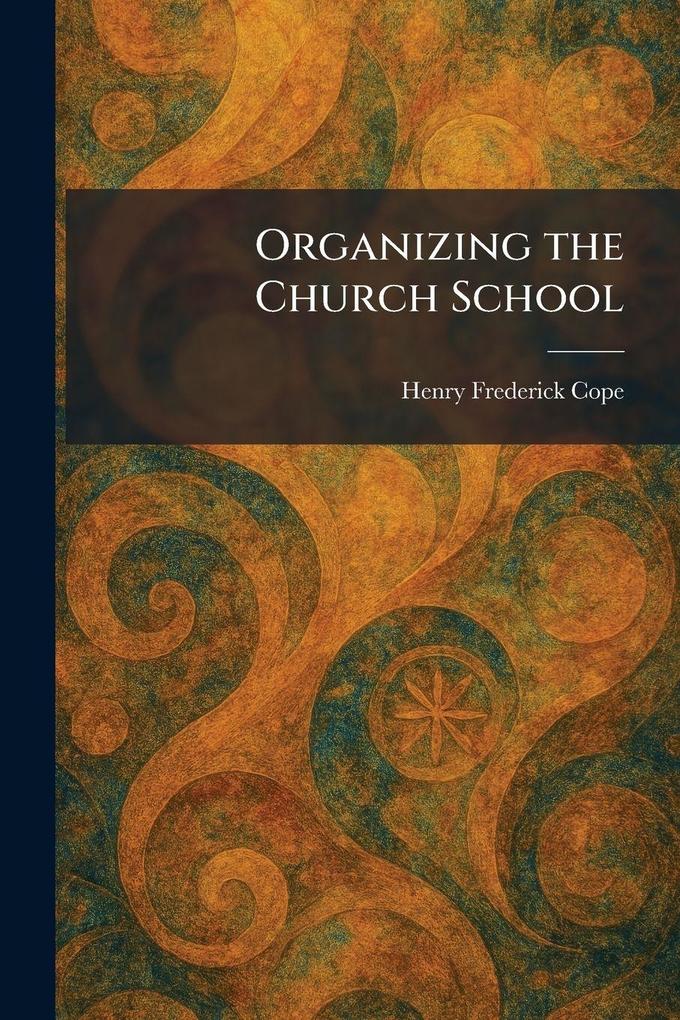
"Organizing the Church School" is a comprehensive manual dedicated to the administrative and pedagogical foundations of religious education. Authored by Henry Frederick Cope, a leading voice in early 20th-century religious education, this work provides a structured framework for managing the educational life of a church community. It advocates for a transition from traditional Sunday school models to a more integrated and professionally organized "church school" system, emphasizing efficiency, clear leadership, and high pedagogical standards.
The text explores the essential components of a successful religious education program, including the recruitment and training of staff, the development of age-appropriate curricula, and the maintenance of physical learning environments. Cope provides practical guidance on the roles of the director of religious education and the various committees necessary to sustain a thriving school. Focusing on the spiritual and social development of the student, the work remains a significant historical resource for understanding the evolution of church administration and the professionalization of Christian teaching. This book is an invaluable tool for those interested in the history of education and the practical methods used to nurture faith through structured community learning.
This work has been selected by scholars as being culturally important, and is part of the knowledge base of civilization as we know it. This work was reproduced from the original artifact, and remains as true to the original work as possible. Therefore, you may see the original copyright references, library stamps (as most of these works have been housed in our most important libraries around the world), and other notations in the work.
This work is in the public domain in the United States of America, and possibly other nations. Within the United States, you may freely copy and distribute this work, as no entity (individual or corporate) has a copyright on the body of the work.
As a reproduction of a historical artifact, this work may contain missing or blurred pages, poor pictures, errant marks, etc. Scholars believe, and we concur, that this work is important enough to be preserved, reproduced, and made generally available to the public. We appreciate your support of the preservation process, and thank you for being an important part of keeping this knowledge alive and relevant.