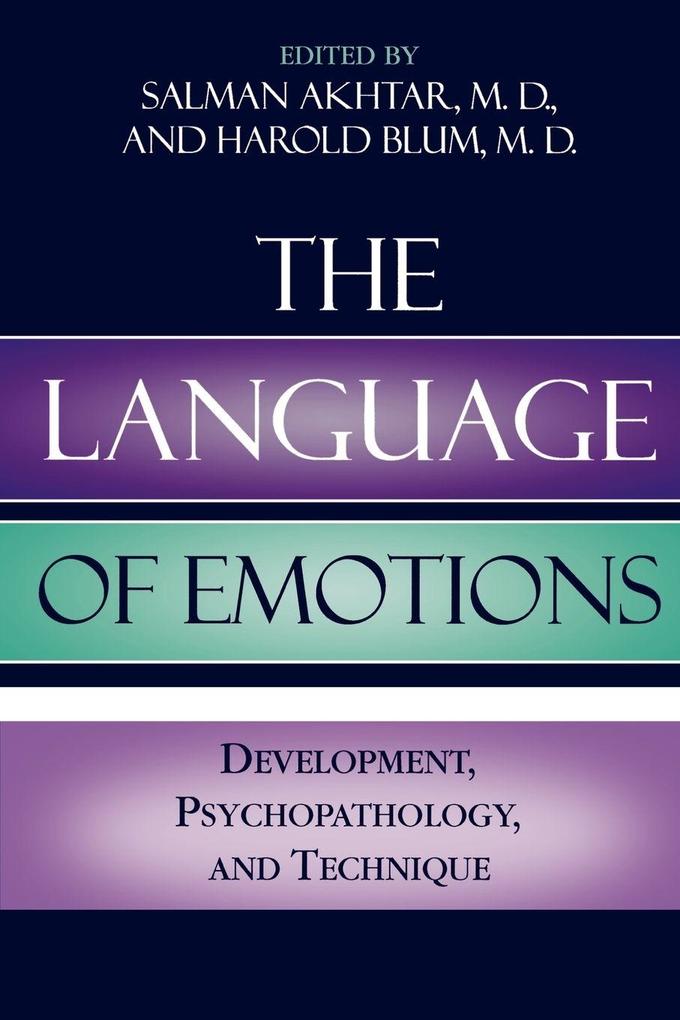
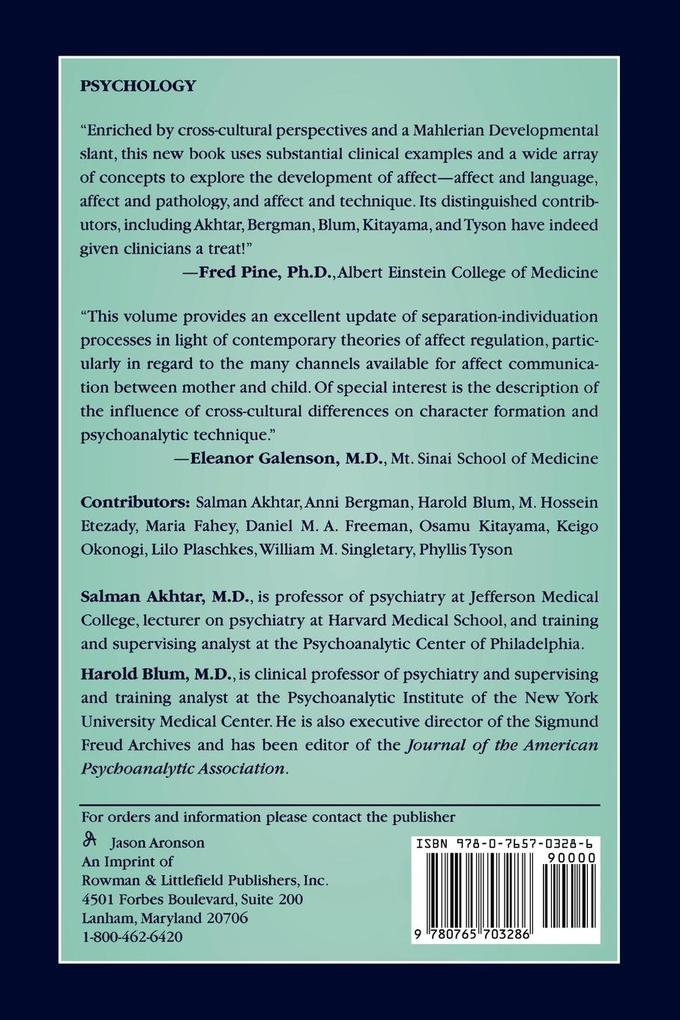
This is a solid book. It should be read by any student of psychoanalysis who is ready and willing to speak a new language. Journal Of The American Psychoanalytic Association The discussions are of high caliber and should provide an important contribution to the advancing understanding of emotion psychoanalytically. Bulletin Of The Menninger Clinic Enriched by cross-cultural perspectives and a Mahlerian Developmental slant, this new book uses substantial clinical examples and a wide array of concepts to explore the development of affect-affect and language, affect and pathology, affect and technique. Its distinguished contributors, including Akhtar, Bergman, Blum, Kitayama, and Tyson have indeed given clinicians a treat! -- Fred Pine, Ph.D. This book explores the many factors that contribute to the development of the capacity to put affects into words. These include the nature of the mother-infant dialogue, the impact of both culture and individual family psychopathology upon attachment, and the unfolding of the separation-individuation process. This book is a fascinating examination of the relationship between developmental forces, cultural values, family dynamics, and clinical practice. It will be of value to all clinicians who, with their patients, struggle to verbalize the non-verbal. -- J. Alexis Burland, M.D., The Psychoanalytic Center of Philadelphia This volume provides an excellent update of separation-individuation processes in light of contemporary theories of affect regulation, particularly in regard to the many channels available for affect communication between mother and child. Of special interest is the description of the influence of cross-cultural differences on character formation and on psychoanalytic technique. -- Eleanor Galenson, M.D., Mt. Sinai School of Medicine