Bücher versandkostenfrei*100 Tage Rückgaberecht***Abholung in über 100 Filialen
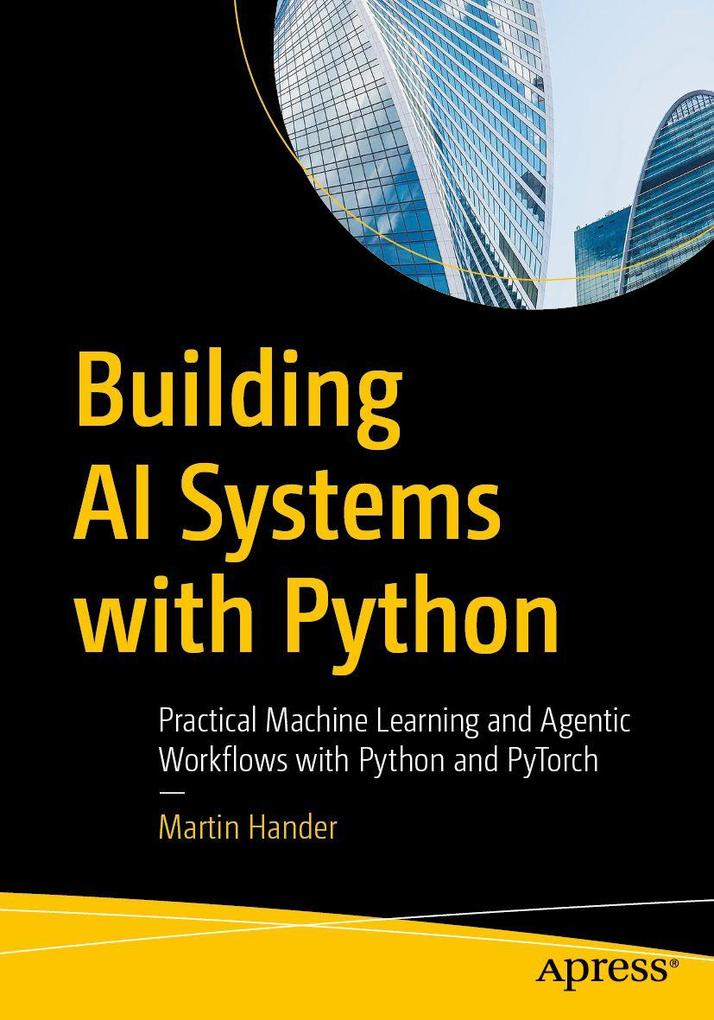
This book is a practical, end-to-end guide for engineers and practitioners who want to move beyond prototypes and confidently deploy machine learning and large language model solutions in real-world environments.
This book guides through the entire modern machine learning lifecycle. You ll start with foundations using NumPy, Pandas, and PyArrow for data pipelines, then build solid baselines with scikit-learn. From there, you advance into deep learning with PyTorch, transformers, and LLM adaptation techniques such as LoRA and QLoRA. You ll explore diffusion and multimodal models, and learn to build retrieval-augmented generation systems with FAISS and pgvector. Practical chapters cover agents, tool use, evaluation frameworks, observability, and responsible AI practices including privacy, safety, and governance. Finally, you ll master deployment techniques using FastAPI, Ray Serve, TorchServe, and cutting-edge LLM serving engines like vLLM and TGI. Each concept is paired with clear code examples, testing patterns, and operational checklists. Instead of one-off tricks, you ll adopt repeatable workflows: schema-first tooling, reproducible training pipelines, evaluation with golden datasets, and secure production rollouts with monitoring and compliance checkpoints.
In the end, this book helps you build systems that are robust, auditable, and optimized whether you're deploying your first model or managing complex enterprise workloads. For engineers who want to ship AI confidently and responsibly, this is your practical playbook for the GenAI era.
What you will learn:
Implement modern AI models including transformers, diffusion, multimodal, recommenders, and RL using practical PyTorch examples.
Fine tune and serve LLMs with LoRA/QLoRA, quantization, RAG, tool calling, structured prompts, and robust evaluation techniques.
Design agentic AI systems with memory, planning, safe tool execution, multi agent patterns, and autonomy evaluation frameworks.
Deploy and run production grade AI with MLOps/LLMOps covering serving, performance tuning, monitoring, cost control, compliance, and edge deployments.
Who this book is for:
This book is designed for practicing machine learning and AI engineers, software engineers moving into applied AI, data scientists building production systems, MLOps/LLMOps practitioners, and technical builders who want to go beyond demos and deploy real-world GenAI, LLM, and PyTorch-based systems at scale.
Inhaltsverzeichnis
Part I Foundations That Ship (with Python). -Chapter 1
Machine Learning for Builders. -
Chapter 2
Data Engineering for ML. -
Chapter 3
Evaluation, Testing & Measurement. -
Chapter 4
ML Software Engineering. -
Chapter 5
Optimization 101 in PyTorch. -
Part II Modern Architectures (PyTorch-First). - Chapter 6
Transformers in PyTorch, . -
Chapter 7
Diffusion & Generative Media. -
Chapter 8
Multimodal Learning. -
Chapter 9
Classical Models That Still Deliver. -
Chapter 10
Reinforcement Learning in Practice. -
Part III LLMs & GenAI in Practice. -Chapter 11
Core Concepts of LLMs. -
Chapter 12
Efficient Model Adaptation. -
Chapter 13
Prompt Engineering That Lasts. -
Chapter 14
Retrieval-Augmented Generation. -
Chapter 15
Tool-Using LLMs. -
Chapter 16
Evaluation & Visibility. -
Chapter 17
Responsible AI Foundations. -
Part IV Agentic AI & Multi-Agent Systems. -Chapters 18 23
Agent architectures, memory, tools, coordination, safety, evaluation. -
Part V MLOps & LLMOps. -Chapters 24 29
Experiment tracking, registries, serving, performance, monitoring, compliance. -
Part VI Edge & Enterprise Deployment. -Chapters 30 32
Edge inference, enterprise integration, security & provenance. -
Part VII Applied Patterns & Production Playbooks. -Chapters 33 38
Copilots, chat systems, analytics, personalization, autonomous workflows, enterprise RAG.
Es wurden noch keine Bewertungen abgegeben. Schreiben Sie die erste Bewertung zu "Building AI Systems with Python" und helfen Sie damit anderen bei der Kaufentscheidung.