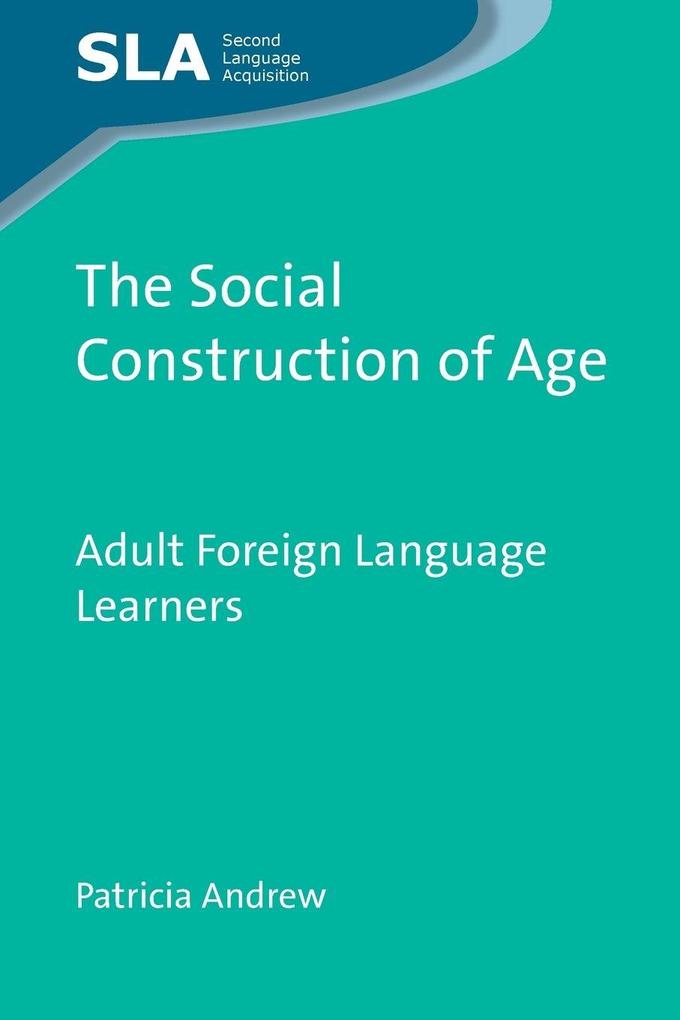
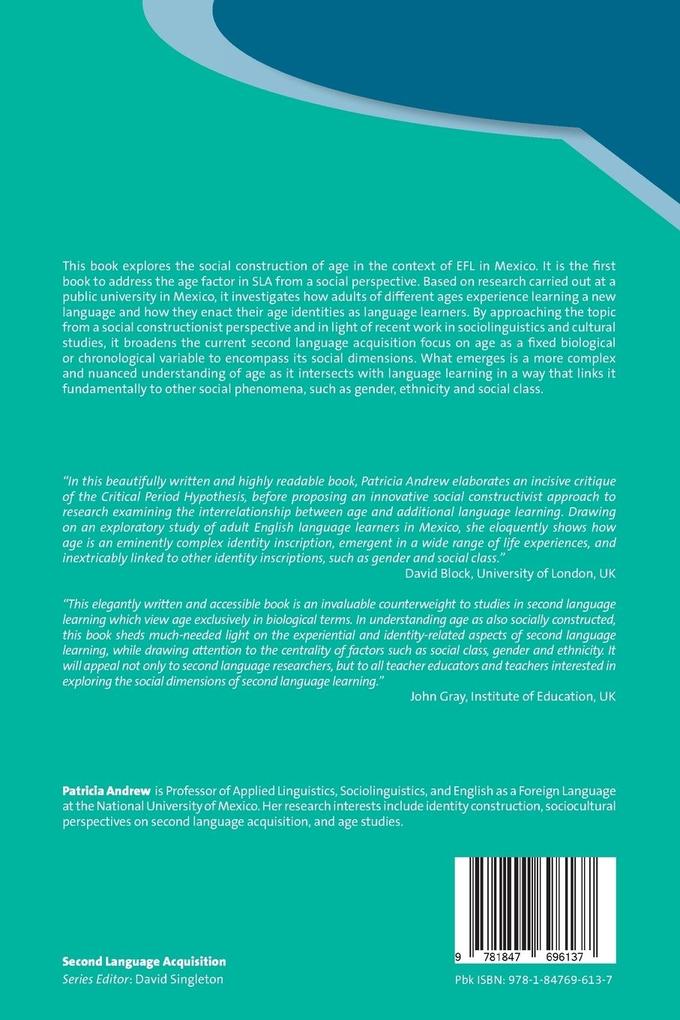
In this beautifully written and highly readable book, Patricia Andrew elaborates an incisive critique of the Critical Period Hypothesis, before proposing an innovative social constructivist approach to research examining the interrelationship between age and additional language learning. Drawing on an exploratory study of adult English language learners in Mexico, she eloquently shows how age is an eminently complex identity inscription, emergent in a wide range of life experiences, and inextricably linked to other identity inscriptions, such as gender and social class.David Block, University of London, UKThis elegantly written and accessible book is an invaluable counterweight to studies in second language learning which view age exclusively in biological terms. In understanding age as also socially constructed, this book sheds much-needed light on the experiential and identity-related aspects of second language learning, while drawing attention to the centrality of factors such as social class, gender and ethnicity. It will appeal not only to second language researchers, but to all teacher educators and teachers interested in exploring the social dimensions of second language learning.John Gray, Institute of Education, UK