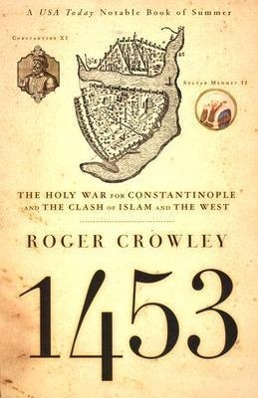
In the spring of 1453, the Ottoman Turks advanced on Constantinople in pursuit of an ancient Islamic dream: capturing the thousand-year-old capital of Christian Byzantium. During the siege that followed, a small band of badly organised defenders, outnumbered ten to one, confronted the might of the Ottoman army in a bitter contest fought on land, sea and underground, and directed by two remarkable men - Sultan Mehmet II and the Emperor Constantine XI. In the fevered religious atmosphere, heightened by the first massed use of artillery bombardment, both sides feared that the end of the world was nigh. The outcome of the siege, decided in a few short hours on 29 May 1453, is one of the great set-piece moments of world history.
A gripping exploration of the fall of Constantinople and its connection to the world we live in today.
The fall of Constantinople in 1453 signaled a shift in history and the end of the Byzantium Empire. Roger Crowley's comprehensive account of the battle between Mehmet II, Sultan of the Ottoman Empire, and Constantine XI, the 57th emperor of Byzantium, illuminates the period in history that was a precursor to the current conflict between the West and the Middle East.
For a thousand years Constantinople was quite simply "the city": fabulously wealthy, imperial, intimidating-and Christian. Singlehandedly it blunted early Arab enthusiasm for Holy War. When a second wave of Islamic warriors swept out of the Asian steppes in the Middle Ages, Constantinople was the ultimate prize: "The Red Apple." It was a city that had always lived under threat. On average it had survived a siege every forty years for a millennium-until the Ottoman Sultan, Mehmet II, twenty-one years old and hungry for glory, rode up to the walls in April 1453 with a huge army, "numberless as the stars."
1453 is the taut, vivid story of this final struggle for the city, told largely through the accounts of eyewitnesses. For fifty-five days a tiny group of defenders defied the huge Ottoman army in a seesawing contest fought on land, at sea, and underground. 1453 is both a gripping work of narrative history and an account of the war between Christendom and Islam that still has echoes in the modern world.