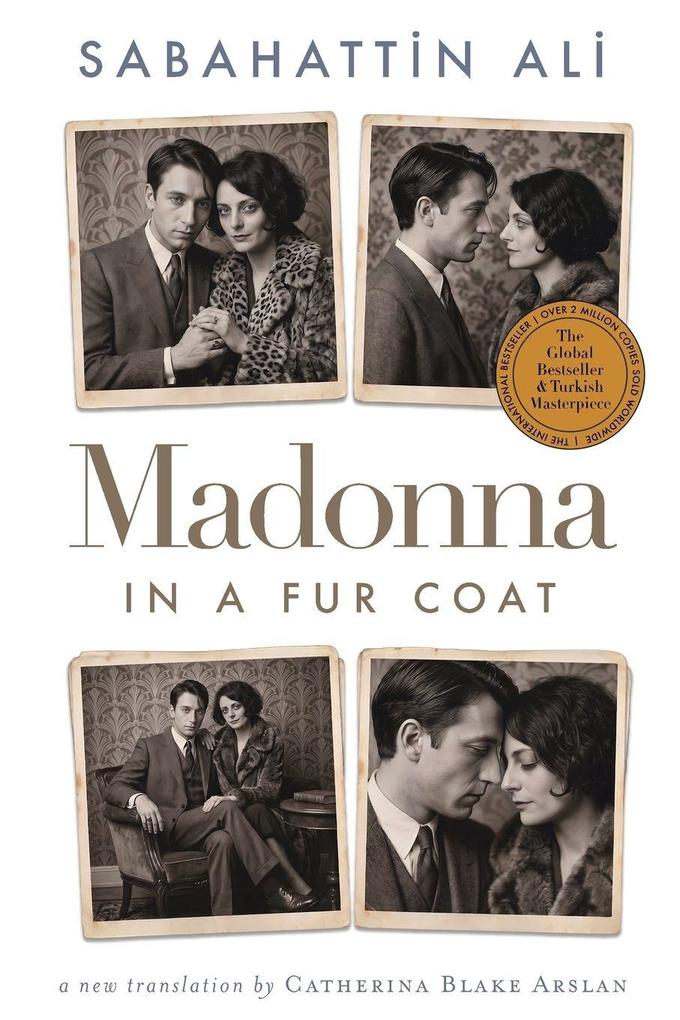
Beneath the velvet collar of a fur coat lies a gaze that could dismantle a man's entire world.
When Raif Efendi, a man of quiet insignificance, encounters a self-portrait in a Berlin art gallery, he doesn't just see a painting-he sees the missing half of his own soul. The woman in the frame is Maria Puder: elusive, fiercely independent, and draped in a melancholy that feels like a homecoming. For Raif, a young Turk sent to Germany to learn the soap trade but destined to lose himself in the galleries and parks of the Weimar Republic, this is the moment his real life begins-and begins to end.
Two Worlds, One Secret
The novel is structured as a haunting excavation. It begins in the dusty, bureaucratic grayness of 1940s Ankara, where a young narrator encounters the elderly Raif Efendi. To the world, Raif is a "superfluous man"-a timid clerk who endures the mockery of his family and the indifference of his colleagues with a strange, stoic silence. He is a ghost walking among the living. But when he falls ill, he entrusts the narrator with a weathered notebook, and the gray walls of Ankara dissolve into the neon-lit, feverish streets of 1920s Berlin.
The Berlin Awakening
The notebook reveals a man the world never knew. In Berlin, Raif is vibrant, observant, and deeply alive. His connection with Maria Puder is a collision of iki lonely orbits in the flickering light of pre-war Europe. Maria is not the traditional "muse" of 20th-century literature; she is a woman who refuses to be possessed, a performer in a cabaret who views the world with a sharp, protective cynicism.
Their romance is not one of grand gestures, but of whispered truths, late-night walks through the Tiergarten, and the terrifying vulnerability of being truly known. It is a relationship built on the "possibility" of understanding-a rare bridge between two people who have spent their lives in isolation.
The Architecture of Regret
But Madonna in a Fur Coat is more than a star-crossed romance. It is a profound meditation on the "unlived life." As the political shadows of the 20th century begin to lengthen, the greatest tragedy isn't the geographical distance between the streets of Berlin and the Anatolian heartland; it is the silence that grows between two hearts.
Sabahattin Ali masterfully explores how a single moment of hesitation, a letter left unread, or a word left unspoken can alter the trajectory of a soul forever. Raif's return to Turkey marks his transition into a "living corpse," a man who has tucked his entire existence into the pages of a diary because the reality of his surroundings is too small to contain his memories.
A Universal Masterpiece
Decades after its first publication in 1943, this novel has emerged from the shadows of Turkish literature to become a global phenomenon. Its power lies in its devastating honesty about the human condition. It asks the reader: How well can we ever truly know the person sitting across from us? In a world that often values noise and bravado, Raif Efendi stands as a monument to the quiet ones-the dreamers who carry entire universes behind their eyes. This is a story for anyone who has ever looked at a stranger and wondered if they were the mirror to their own soul. It is a haunting, timeless reminder that the most significant wars are often the ones fought in the silence of our own hearts.