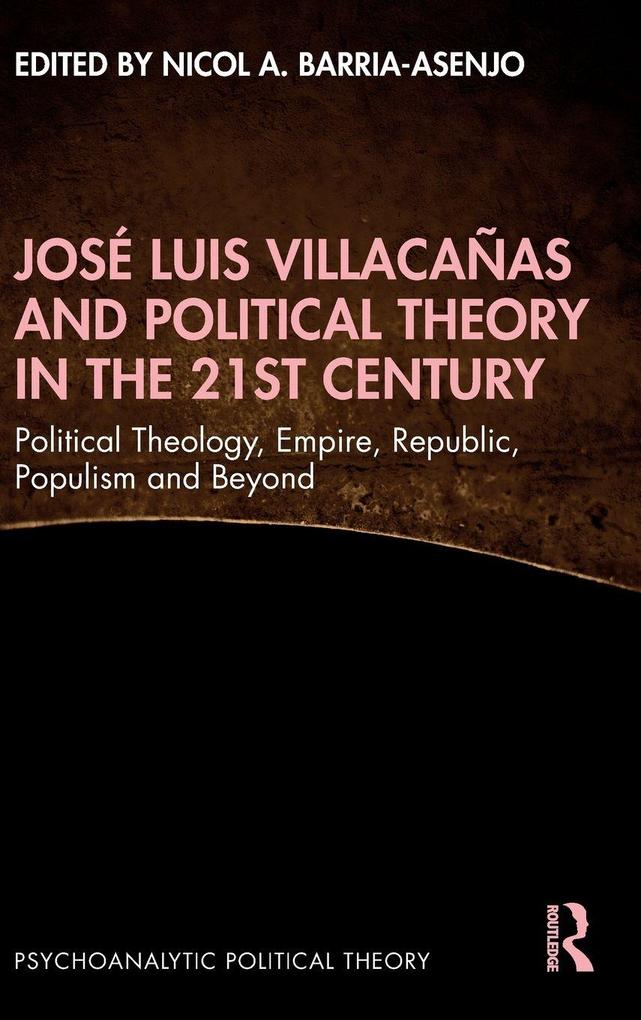
With this book, Nicol A. Barria-Asenjo and her team of experts introduce in a systematic and comprehensive way the work of political philosopher, José Luis Villacañas, in the fields of political theory, philosophy, and psychoanalysis.
Considered one of the most prolific contemporary philosophers in Spain, with both national and international impact, Villacañas' scholarship is characterized by social and political critique with elements of Freudian and Lacanian psychoanalysis and its links to populist perspectives. Divided into two parts, short and succinct chapters examine various aspects of Villacañas' intellectual production that spans over four decades.
Inhaltsverzeichnis
Foreword. Introduction. SECTION I. The emergence of a constellation of signifiers. Six pillars in a philosophical monument. 1. Thirty Relevant Concepts SECTION II. Villacañas as a rupture in the history of ideas in the 21st century. Darkness and Light to History and Political Theory. 2. A general cartography of the work of the philosopher José Luis Villacañas: First steps towards an intellectual biography. 3. Writing as officium and translatio of the philosopher. 4. Return to Max Weber. The relevance of Max Weber in the republicanism of José Luis Villacañas. 5. Defending the Enlightenment Today!A Gloss on José Luis Villacañas's Freudo-Republicanism 6. Villacañas, a Reader of Foucault: On the Question of Anthropology SECTION III. Conceptual renovation and construction of concepts: an approach to political theory in Villacañas. 7. The Ability to Judge as an Act of Freedom - A Critical Examination with Reference to Villacañas' Concept of "Precarious Lives" 8. Tempora mutantur 9. Subject, Capitalist Discourse, and Neoliberalism: Notes on the Contemporary World, in Dialogue Between Psychoanalysis and the Thought of Villacañas 10. Civic Republicanism as an Alternative to Neoliberalism: An Analysis of José Luis Villacañas's Thought 11. Theological-political fragment. Neoliberalism and totality in José Luis Villacañas. SECTION IV. An old, repeated and necessary debate: Why talk about Populism? 12. Philosophy as a Collaborative Work: On Villacañas' Commentary on the Enlightenment and Populism 13. José Luis Villacañas: The Republic and the Populist Moment. 14. Populism in Latin America: An analysis of the Latin American political situation from the thought of José Luis Villacañas Berlanga. 15. Is it possible to talk about populism today? An exploration between Latin America and the Philippines from the work of Villacañas. Afterword.