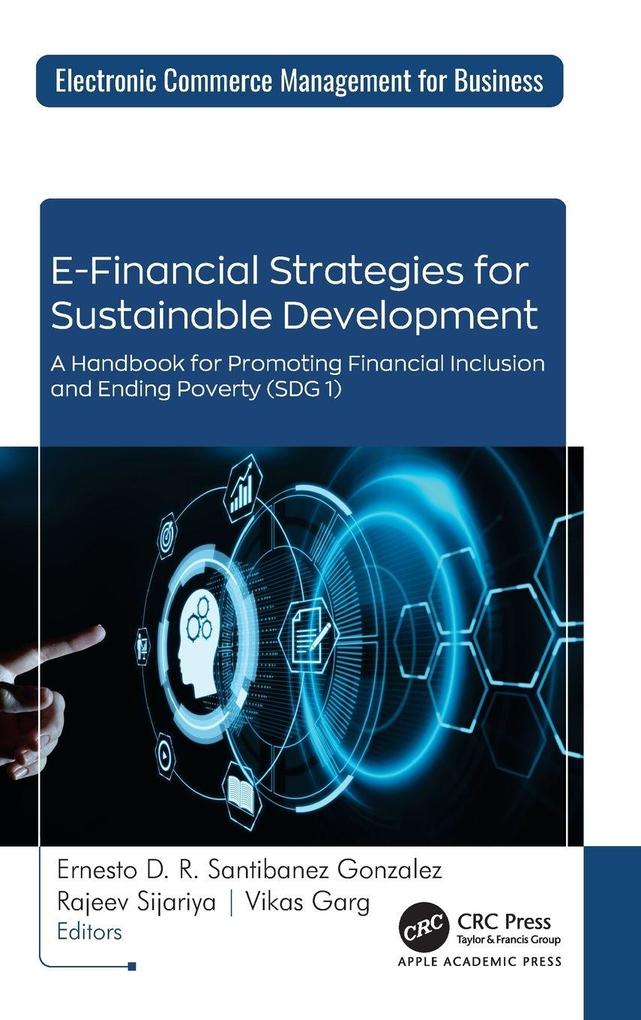
Attaining sustainable development today is more urgent than ever, owing to rapid technological advances and evolving financial landscapes. This new book, E-Financial Strategies for Sustainable Development: A Handbook for Promoting Financial Inclusion and Ending Poverty (SDG 1), explores the intersection of technology and finance, offering insights into how digital tools can be harnessed to promote financial inclusion and drive poverty alleviation efforts.
The book delves into the various components of financial inclusion, such as mobile banking, fintech innovations, financial policies, etc., providing a thorough analysis of their potential to transform the economic landscape in a practical and scalable manner. It deliberates on unique concepts such as climate finance, carbon drifts/carbon trading, etc.
It also discusses the capabilities and importance of continued development in both AI and sustainability to address the complex challenges facing the investment community. It discusses how digital tools have transformed financial access for underprivileged people and how e-financial strategies can empower women entrepreneurs in India and beyond.
The importance of financial literacy, including digital financial literacy, is also addressed, exploring its potential to reduce poverty and attain financial inclusion for all. The book considers the intricacies of financial systems, highlighting the unique characteristics of each market and their implications for portfolio management. The significance of artificial intelligence (AI) tools in navigating intricate markets is also investigated.
Capitalizing on case studies and best practices from around the world, the book highlights success stories, challenges as well as valuable lessons.
This book will serve as a valuable resource for policymakers, financial institutions, development practitioners, and stakeholders who are committed to leveraging electronic financial strategies to achieve sustainable development. By presenting a global perspective, this book underscores the universality of the need for financial inclusion while acknowledging the uniqueness of regional challenges.
Inhaltsverzeichnis
1. Unravelling the Complex Web of Climate Finance Barriers in India: An Integrated ISM and Fuzzy MICMAC Analysis 2. Smart Sustainability: Harnessing AI for Investment Monitoring 3. Digital Financial Revolution: Empowering Lives through E-Financial Strategies 4. Understanding Youth Perspectives on Climate Change: Shaping Tomorrow 5. Breaking Barriers: How Technology Is Revolutionizing Access to Financial Services for the Underserved 6. Empowering Her Enterprise: A Comprehensive Review of E-Financial Strategies Catalyzing Women Entrepreneurship in India 7. Rural Maharashtra: Microfinance Growth and Microfinance Providers Challenges in Implementing e-Financial Strategies 8. Financial Literacy and Financial Behavior of People in India with Special Reference to Agra, The City of the Taj Mahal 9. Portfolio Management in Different Markets of Financial Systems: An Optimal Investment Approach with AI Tools 10. An Empirical Study of Saving Behavior: Evidence from India 11. Green Bonds: Building a Sustainable Financial Future 12. Navigating Prosperity: A Bibliometric Analysis of Financial Literacy and Sustainable Development Goals 13. Role of Artificial Intelligence in FinTech and Banks: Challenges and Future Research Agenda 14. Strategies for Promoting Financial Literacy: Empowering Vulnerable and Marginalized Populations to Achieve SDG 1