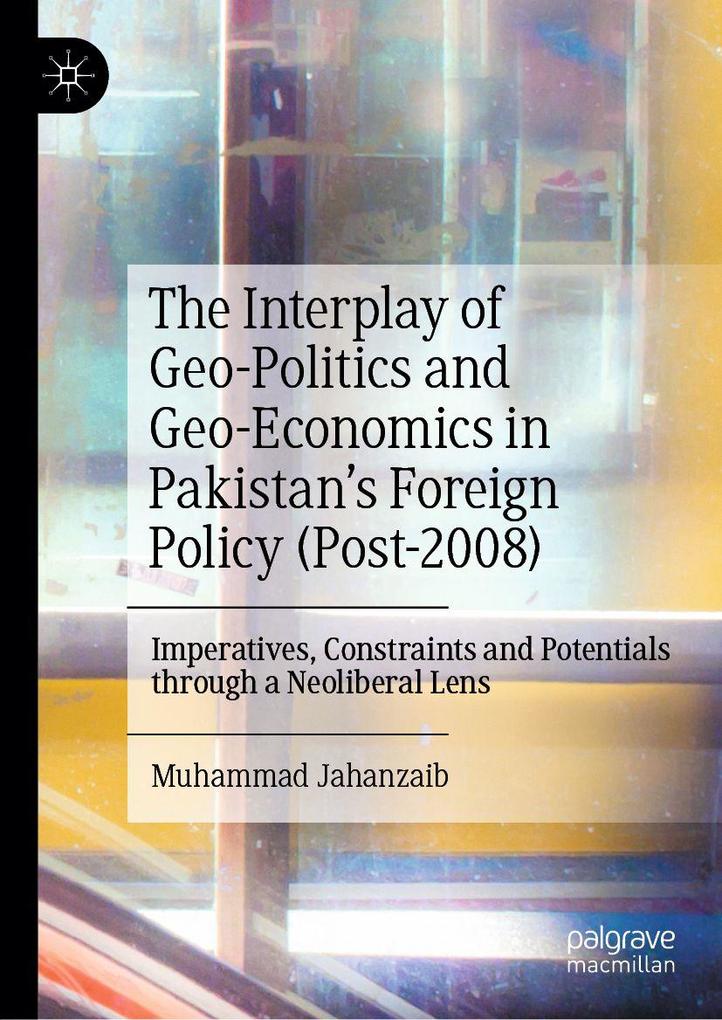
This book focuses on how Geo-Politics and Geo-Economics jointly shape Pakistan s foreign policy, tracing the country s strategic shift from security-driven doctrines to prioritized Geo-Economic imperatives after 2008. Drawing on in-depth case studies and rigorous qualitative analysis under a neoliberal framework, it demonstrates how economic ambitions recalibrate relations with major powers, neighbours and the Muslim world. The book assesses opportunities, constraints and strategic trade-offs, and situates Pakistan s agency within an evolving global order.
Geared to scholars, policymakers and strategic practitioners of both public and private sectors, the study combines empirical evidence with policy-relevant analysis and recommendations to illuminate Pakistan s diplomatic and economic strategies. Readers will gain a concise, integrated understanding of Pakistan s historical drivers and future prospects, along with practical insights into economic diplomacy and political economy. The book also equips policymakers and analysts with support to evaluate policy choices that balance security, sovereignty, and development. By linking theory to practice, this work offers a timely, actionable framework for understanding Pakistan s prioritization from Geo-Politics to Geo-Economics and its implications for regional and global strategy.
Inhaltsverzeichnis
Chapter One: Introduction and Theoretical Framework. -Chapter Two: The Geopolitical Dimension. -Chapter Three: Geo-Economic Reorientation. -Chapter Four: The Interplay of Geo-Politics and Geo-Economics. -Chapter Five: Impacts of Transition. -Chapter Six: National Imperatives, Constraints, and Potentials
Es wurden noch keine Bewertungen abgegeben. Schreiben Sie die erste Bewertung zu "The Interplay of Geo-Politics and Geo-Economics in Pakistan's Foreign Policy (Post-2008)" und helfen Sie damit anderen bei der Kaufentscheidung.