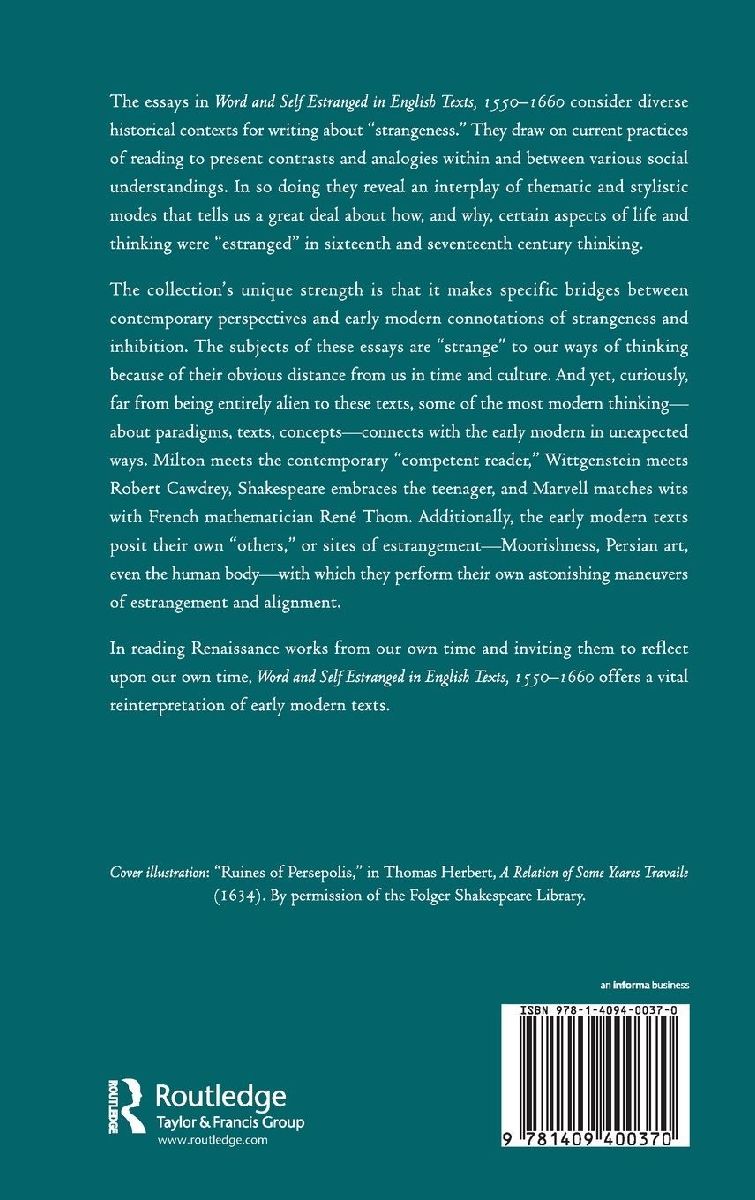
All of the essays in this collection investigate and extrapolate understandings of the strange. In presenting contrasts and analogies between diverse kinds of estrangement, the volume reveals an interplay of thematic and stylistic discourses that sheds new light on the place of word and self in English Renaissance writings, and offers a vital reinterpretation of early modern texts.
Inhaltsverzeichnis
Contents: Introduction: word and self estranged: topographies on meaning in early modern England, Philippa Kelly and L.E. Semler; Part 1 The Two-Way Mirror: the Natural and the Strange: Wittgenstein and early English dictionaries, 1604-1658, Julian Lamb; The ruins of Persepolis: grotesque perception in Thomas Herbert's Travels, L.E. Semler; Intimate converse with nature: body and touch in Harvey's way of inquiry, Alan Salter; Dipsas and traditions of the serpent-woman in early modern literature, Alison V. Scott. Part 2 Shakespeare's Estranged Words: Shakespeare and authenticity: teaching the real thing, Jean E. Howard; Estranging word and self in Twelfth Night, R.S. White; Desdemona's wooing: towards a pre-1538 Othello, Lawrence Warner; A mind diseased: reading Lady Macbeth's madness, Chris Couche. Part 3 Re-Sounding Words: Topographies of space, time and disciplinarity in early modern English: the case of Andrew Marvell, Bob Hodge; The text estranged: topographies of irony in Chaucer and Milton, Ronald Bedford; Sounds of elevation in Paradise Lost: God's commendation of Abdiel, William Walker; By the rivers of Babylon: Biblical allusion and the politics of pastoral in Izaak Walton's The Compleat Angler, Kirsten Tranter; 'Transitory hieroglyphiques': deaf people and signed communication in early modern theories of language, Susannah Macready; Index.