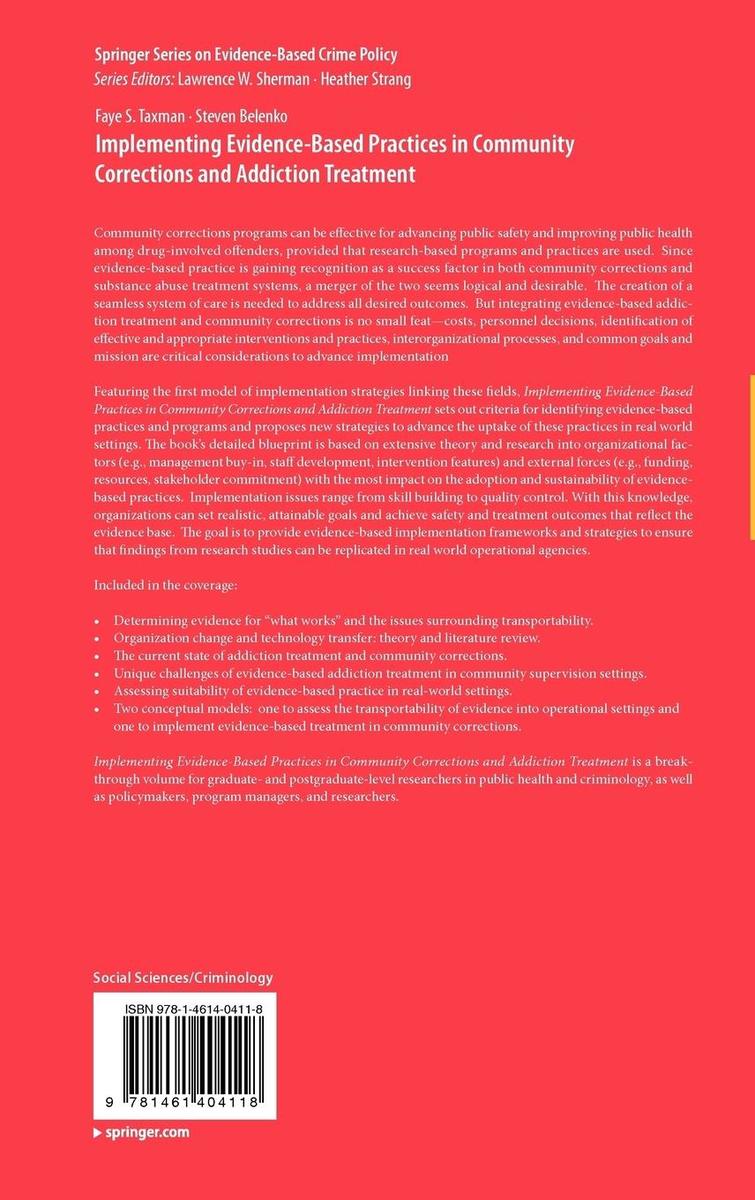
Community corrections programs are emerging as an effective alternative to incarceration for drug-involved offenders, to reduce recidivism and improve public health and public safety. Since evidence-based practice is gaining recognition as a success factor in both community systems and substance abuse treatment, a merger of the two seems logical and desirable. But integrating evidence-based addiction treatment into community corrections is no small feat-costs, personnel decisions, and effective, appropriate interventions are all critical considerations.
Featuring the first model of implementation strategies linking these fields, Implementing Evidence-Based Practices in Community Corrections and Addiction Treatment sets out criteria for identifying practices and programs as evidence. The book's detailed blueprint is based on extensive research into organizational factors (e. g. , management buy-in) and external forces (e. g. , funding, resources) with the most impact on the adoption of evidence-based practices, and implementation issues ranging from skill building to quality control. With this knowledge, organizations can set realistic, attainable goals and achieve treatment outcomes that reflect the evidence base.
Included in the coverage:
- Determining evidence for "what works."
- Organization change and technology transfer: theory and literature review.
- The current state of addiction treatment and community corrections.
- Unique challenges of evidence-based addiction treatment under community supervision.
- Assessing suitability of evidence-based practice in real-world settings.
- A conceptual model for implementing evidence-based treatment in community corrections.
Implementing Evidence-Based Practices in Community Corrections and Addiction Treatment is a breakthrough volume for graduate- and postgraduate-level researchers incriminology, as well as policymakers and public health researchers.
Inhaltsverzeichnis
Introduction. - Theories of Organizational Change Approaches. - Determining the Evidence Base for Addiction Treatment Programs. - Technology Transfer Process and Models. - Current State of the Corrections Field. - Current State of the Addiction Treatment Field. - The Nuances of the Correctional and Addiction Treatment Environments. - Substance Abuse Agencies. - A Conceptual Model of Technology Transfer of Evidence-Based treatment to Community Corrections. - Supporting the Model. - The Challenges of Intervention Fidelity. - Expanding the Concept for Evidence-Based Practice. - Adapting to the Environment. - Conclusion and Recommended Next Steps.