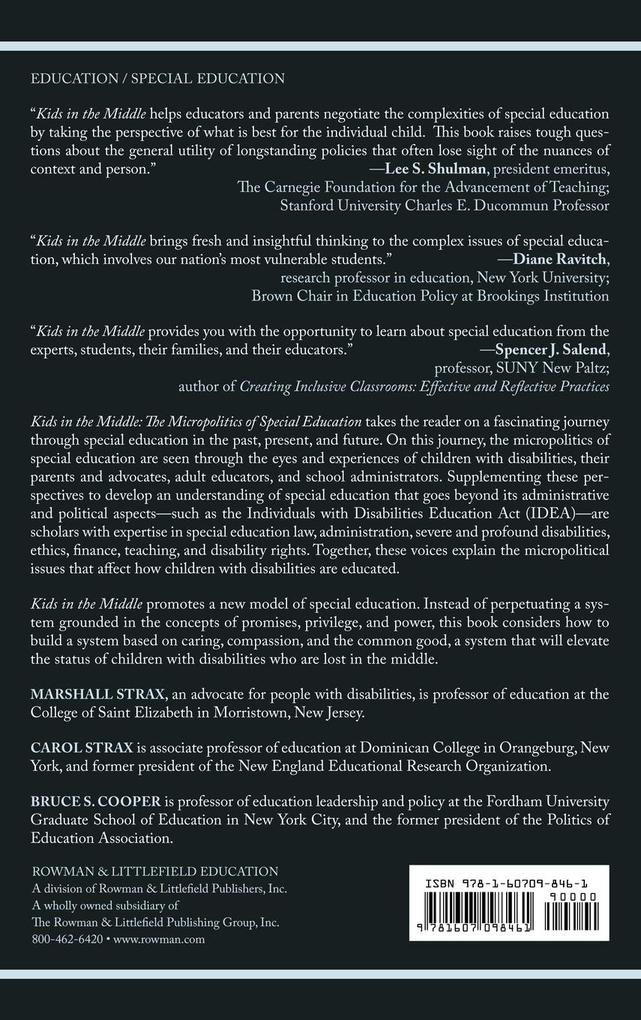
Kids in the Middle: The Micro-Politics of Special Education takes the reader on a fascinating journey through special education in the past, present, and future. On this journey, the micro-politics of special education are seen through the eyes and experiences of children with disabilities, their parents and advocates, adult educators, and school administrators. Supplementing these perspectives to develop an understanding of special education that goes beyond its administrative and political aspects, such as the Individuals with Disabilities Education Act (IDEA), are scholars with expertise in special education law, administration, severe and profound disabilities, ethics, finance, teaching, and disability rights. Together, these voices explain the micro-political issues that affect how children with disabilities are educated. Kids in the Middle promotes a new model of special education to help transform special education. Instead of perpetuating a system grounded in the concepts of promises, privilege, and power, this book considers how to build a system based on caring, compassion, and the common good, a system that will elevate the status of special education children who are lost in the middle.
Inhaltsverzeichnis
Contributors< BR> < BR> Foreword< BR> < BR> Preface < BR> < BR> Part I Politics of the Past: From Segregation to Integration < BR> < BR> Chapter 1:Borderline: The Political Divide in Special Education< BR> Marshall Strax, College of Saint Elizabeth< BR> < BR> Chapter 2: Schooling Tommy in the Past: A Personal Perspective< BR> Thomas E. Strax, UMDNJ-RWJ Medical School< BR> Lisa Luciano, UMDNJ-RWJ Medical School< BR> Anna Dunn, UMDNJ-RWJ Medical School< BR> < BR> Chapter 3:Free At Last? Legislation for Children with Disabilities< BR> Allan Osborne, Retired Principal, Snug Harbor Community School< BR> Charles Russo, University of Dayton < BR> < BR> Part II Politics of the Present: Law and Finance < BR> < BR> Chapter 4:The Limits of Freedom: Legislation and Litigation in Special Education< BR> Charles Russo, University of Dayton< BR> Allan Osborne, Retired Principal, Snug Harbor Community School< BR> < BR> Chapter 5: The Costs and Benefits of Special Education< BR> Bruce S. Cooper, Fordham University< BR> < BR> Chapter 6:Kid in the Middle: A Case Study of an Impartial Hearing < BR> Carol Strax, Dominican College < BR> Marshall Strax, College of Saint Elizabeth< BR> < BR> Part III Politics of the Present: Reality on the Ground < BR> < BR> Chapter 7: Common Confusions with Inclusion< BR> David Connor, Hunter College< BR> < BR> Chapter 8: Don't Ask, Don't Tell, Don't Pay: Services for Children with Severe and Chronic Disabilities< BR> Arnold Danzig, Arizona State University < BR> < BR> Chapter 9: Schooling Tommy in the Present< BR> Catherine Hall Rikhye, Retired Director, Office of Inclusive Education< BR> < BR> Part IV Politics of the Future< BR> < BR> Chapter 10:Voices From the Field: Students Speak Out< BR> Carol Strax, Dominican College< BR> < BR> Chapter 11:Voices From the Field: Parents Speak Out< BR> Carol Strax, Dominican College< BR> < BR> Chapter 12:Voices From the Field: Education Professionals< BR> Carol Strax, Dominican College < BR> < BR> Chapter 13:Schooling Tommy in the Future: The Ideal< BR> Marshall Strax, College of Saint Elizabeth