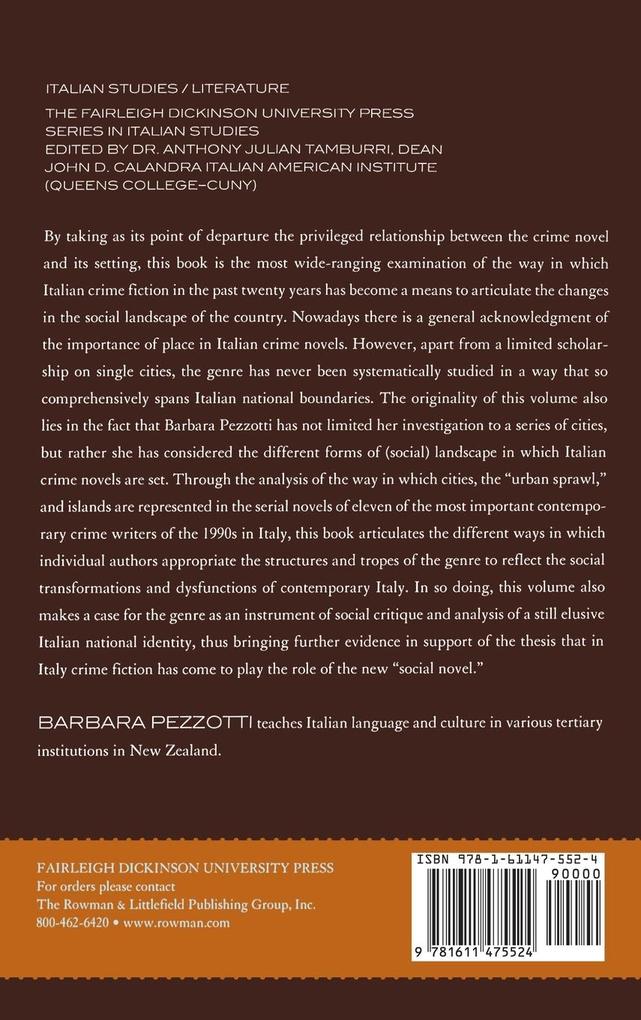
An analysis of the relationship between detective fiction and its setting, this book is the most wide-ranging examination of the way in which Italian detective fiction in the last 20 years has become a means to articulate the changes in the social landscape of the country.
Inhaltsverzeichnis
Contents: < BR> Epigraphs< BR> Contents< BR> Acknowledgments< BR> Introduction< BR> Part I: Giallo and the City < BR> 1 Milan, the city of crime< BR> Piero Colaprico and Pietro Valpreda's 'Dynamic' Milan< BR> Andrea G. Pinketts' Grotesque Milan< BR> Sandrone Dazieri and a Manichean Image of the City< BR> 2 Turin, between History and News< BR> Bruno Ventavoli and the 'Savoy Kasbah'< BR> Piero Soria and the Renewal of Turin's Pride< BR> 3 Naples, the sulphurous city< BR> Siviero's Naples as the Dystopian City of the Future< BR> 4 Palermo, beauty and the Mafia< BR> Piazzese and a Schizophrenic Palermo< BR> Part II: Giallo and urban sprawl< BR> 5 Bologna and the Via Emilia< BR> Carlo Lucarelli and a Dilating Bologna< BR> 6 Italy's North-east, the Corroded Engine of Italy< BR> Massimo Carlotto and the Alligator series< BR> Part III: Giallo and the Island< BR> 7 Sicily between Old and New< BR> Andrea Camilleri and Vigàta, the Imaginary 'Island'< BR> 8 Sardinia, the Motherland< BR> Marcello Fois and his Contemporary Trilogy< BR> Conclusion < BR> Part IV: Interviews< BR> Bibliography < BR> Index < BR> About the Author