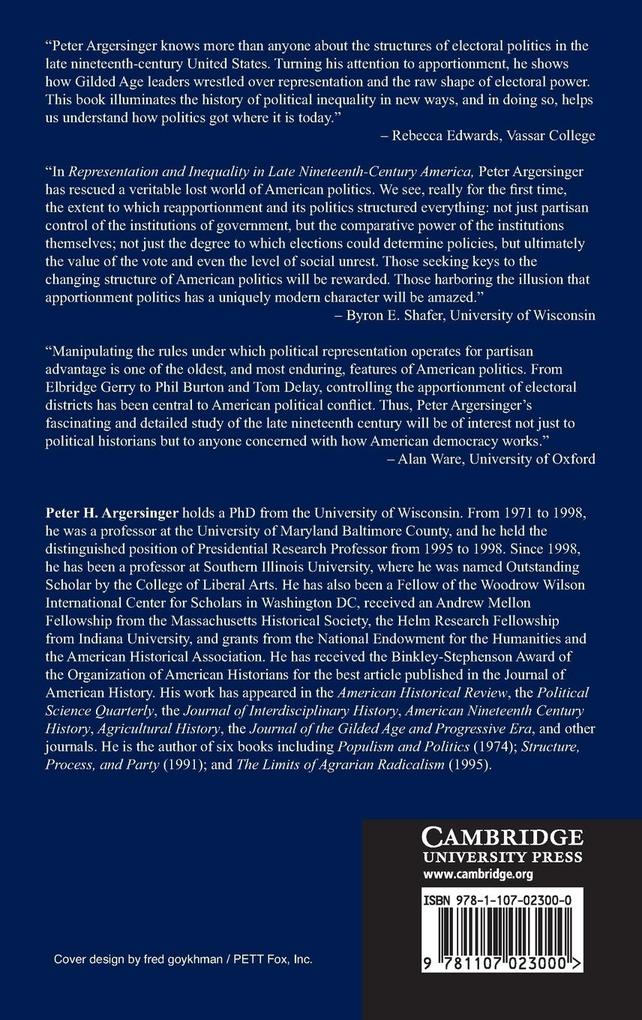
"Peter Argersinger knows more than anyone about the structures of electoral politics in the late nineteenth-century United States. Turning his attention to apportionment, he shows how Gilded Age leaders wrestled over representation and the raw shape of electoral power. This book illuminates the history of political inequality in new ways, and in doing so, helps us understand how politics got where it is today." - Rebecca Edwards, Vassar College "Representation and Inequality in Late Nineteenth-Century America is a thoroughly researched and finely crafted account tackling the much neglected subject of legislative apportionment during the Gilded Age. Argersinger exposes the intellectual gymnastics and hardball politics of legislators, governors, and judges as they subverted the democratic process through partisan-inspired gerrymandering. In the process, they grappled with such fundamental concepts as representation, community, and political parties. Apportionment issues roiled politics across the Midwest as partisans indignantly railed against redistricting schemes that threatened to do to them what they were determined to do to their opponents." - John F. Reynolds, University of Texas at San Antonio "In Representation and Inequality in Late Nineteenth-Century America, Peter Argersinger has rescued a veritable lost world of American politics. We see, really for the first time, the extent to which reapportionment and its politics structured everything: not just partisan control of the institutions of government, but the comparative power of the institutions themselves; not just the degree to which elections could determine policies, but ultimately the value of the vote and even the level of social unrest. Those seeking keys to the changing structure of American politics will be rewarded. Those harboring the illusion that apportionment politics has a uniquely modern character will be amazed." - Byron E. Shafer, University of Wisconsin "This deeply researched and engaging study provides major insights into issues of representation and the political conflict in the Midwest during the 1890s. Deftly weaving the stories of different state struggles over apportionment, Argersinger carefully lays out the developing political and legal arguments and the various roles of legislatures, state officials, party leaders, and the courts. He adds significantly to our understanding of the watershed nature of the 1890s by showing the brutal political struggle that occurred over apportionment and explaining how and why the issue disappeared thereafter." - Philip VanderMeer, Arizona State University "Manipulating the rules under which political representation operates for partisan advantage is one of the oldest, and most enduring, features of American politics. From Elbridge Gerry to Phil Burton and Tom Delay, controlling the apportionment of electoral districts has been central to American political conflict. Thus, Peter Argersinger's fascinating and detailed study of the late nineteenth century will be of interest not just to political historians but to anyone concerned with how American democracy works." - Alan Ware, University of Oxford