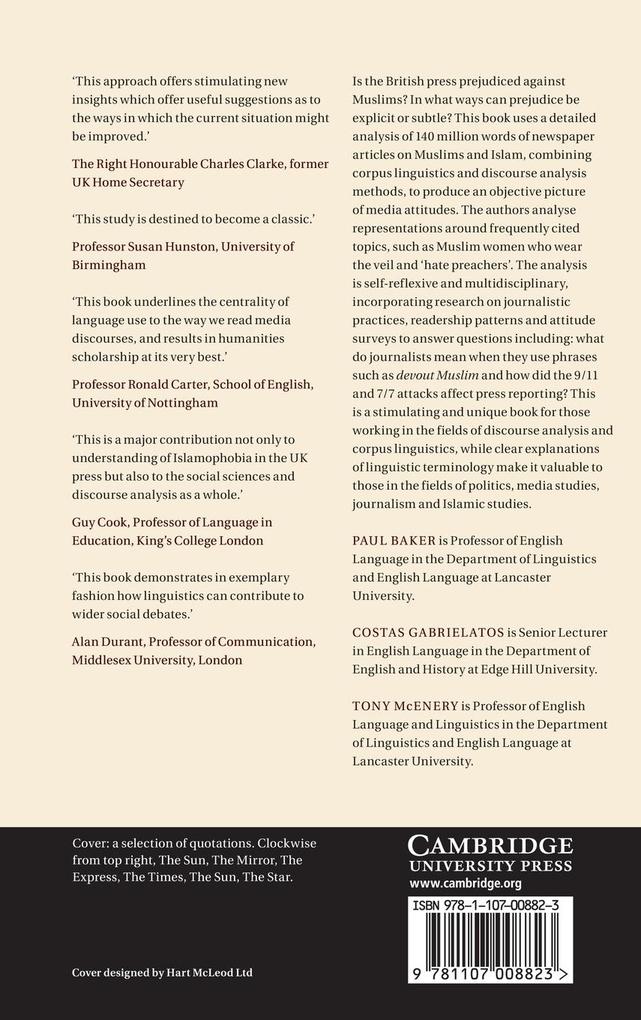
Advance praise: 'This book investigates the ways in which the lives and actions of Muslims and Islam are represented in the British press. The authors use the corpus method of analysing vast amounts of data to weigh the overall impact of the media coverage. This approach offers stimulating new insights which offer useful suggestions as to the ways in which the current situation might be improved.' Rt Hon Charles Clarke, Former UK Home Secretary 'This study is destined to become a classic. It provides detailed evidence of how press influence works, and elegantly demonstrates the strength of corpus linguistics as a research tool.' Susan Hunston, University of Birmingham 'Understanding the representation of Islam in the Western media is a major challenge that demands a balanced approach supported by real data. The methods that enhance this book throughout are rich in insight, comprehensive in vision and evidential at their core. Integrating large corpus-linguistic-informed databases with the qualitative accents of critical discourse analysis the book underlines the centrality of language use to the way we read media discourses and results in humanities scholarship at its very best.' Ronald Carter, University of Nottingham 'This excellent and very accessible book not only provides key insights into a topic of major social and political importance, it also clearly demonstrates the power of corpus linguistics to provide hard factual evidence for critical discourse analysis. This is a major contribution, not only to understanding of Islamophobia in the UK press, but also to the social sciences and discourse analysis as a whole.' Guy Cook, King's College London '[This book] uses corpus linguistic analysis to show how selective linguistic patterning in newspapers creates an overwhelmingly negative point of view in contemporary press coverage of Islam. Research approach and method are precisely defined, analytic techniques clearly explained and illustrated, and inferences from data weighed up in meticulous and even-handed exposition. The book demonstrates in exemplary fashion how linguistics can contribute to wider social debates; it will be of value not only to scholars and students in corpus linguistics and discourse analysis but also in other fields concerned with public representations of Islam or with problems of media responsibility.' Alan Durant, Middlesex University