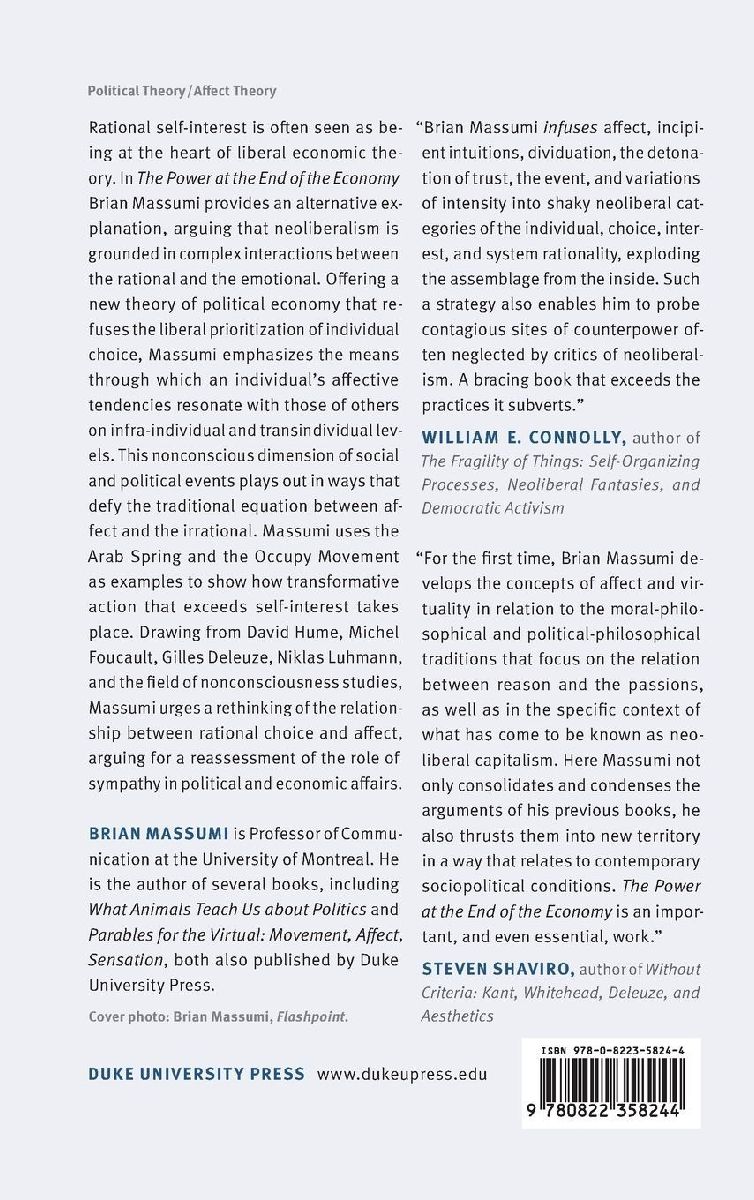
Rational self-interest is often seen as being at the heart of liberal economic theory. In The Power at the End of the Economy Brian Massumi provides an alternative explanation, arguing that neoliberalism is grounded in complex interactions between the rational and the emotional. Offering a new theory of political economy that refuses the liberal prioritization of individual choice, Massumi emphasizes the means through which an individual’s affective tendencies resonate with those of others on infra-individual and transindividual levels. This nonconscious dimension of social and political events plays out in ways that defy the traditional equation between affect and the irrational. Massumi uses the Arab Spring and the Occupy Movement as examples to show how transformative action that exceeds self-interest takes place. Drawing from David Hume, Michel Foucault, Gilles Deleuze, Niklas Luhmann and the field of nonconsciousness studies, Massumi urges a rethinking of the relationship between rational choice and affect, arguing for a reassessment of the role of sympathy in political and economic affairs.
Inhaltsverzeichnis
1. The Inmost End 1
The Market in Wonderland 2
System Distrust 6
Collapse of the Affective Wave Packet 10
2. A Doing Done through Me 19
Deliberation without Attention 21
Jamming Rational Choice 24
The Primes of Life 26
Toward a Politics of Dividualism 32
Double Involuntary / Autonomy of Decision 36
Fielding the Event 43
Tribunals of Reason 48
Finessing the Event 53
3. Beyond Self-Interest 57
Your Life or My Little Finger? 58
Contiguity, Most Distant 65
The Argument from Intensity 68
The Other Sign of Passion 73
A Freedom of the Event 79
The Flashpoint of Sympathy 84
Toward an Anticapitalist Art of the Event 93
Supplements
I. The Affective Tasks of Reason 97
II. Keywords for Affect 103
Notes 113
Works Cited 121
Index 127