Bücher versandkostenfrei*100 Tage Rückgaberecht***Abholung in über 100 Filialen

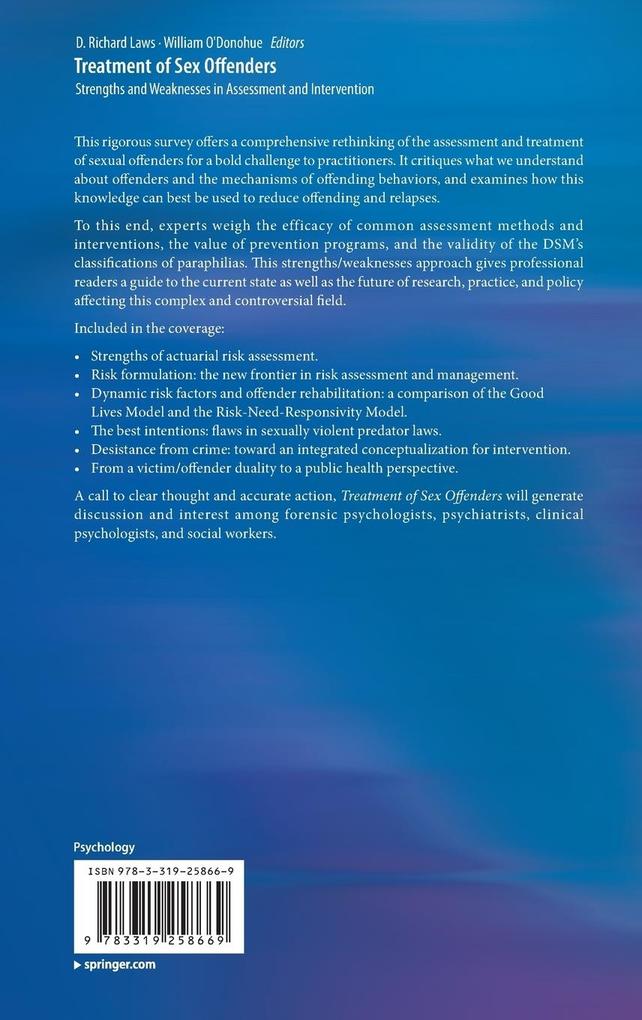
This rigorous survey offers a comprehensive rethinking of the assessment and treatment of sexual offenders for a bold challenge to practitioners. It critiques what we understand about offenders and the mechanisms of offending behaviors, and examines how this knowledge can best be used to reduce offending and relapses.
To this end, experts weigh the efficacy of common assessment methods and interventions, the value of prevention programs, and the validity of the DSM's classifications of paraphilias. This strengths/weaknesses approach gives professional readers a guide to the current state as well as the future of research, practice, and policy affecting this complex and controversial field.
Included in the coverage:
A call to clear thought and accurate action, Treatment of Sex Offenders
will generate discussion and interest among forensic psychologists, psychiatrists, clinical psychologists, and social workers.
Inhaltsverzeichnis
The intended audience is forensic psychologists, psychiatrists, clinical psychologists, and social workers. The book is written by an international collection of authors from the U. S. , the U. K. , Canada, Germany, and New Zealand. This book does a good job of discussing both theoretical and clinical issues. The strengths/weaknesses approach helps clinicians to better understand what works and what does not. It should be in the libraries of professionals and researchers who work with sexual offenders. (Gary B. Kaniuk, Doody' s Book Reviews, August, 2016)
Es wurden noch keine Bewertungen abgegeben. Schreiben Sie die erste Bewertung zu "Treatment of Sex Offenders" und helfen Sie damit anderen bei der Kaufentscheidung.











