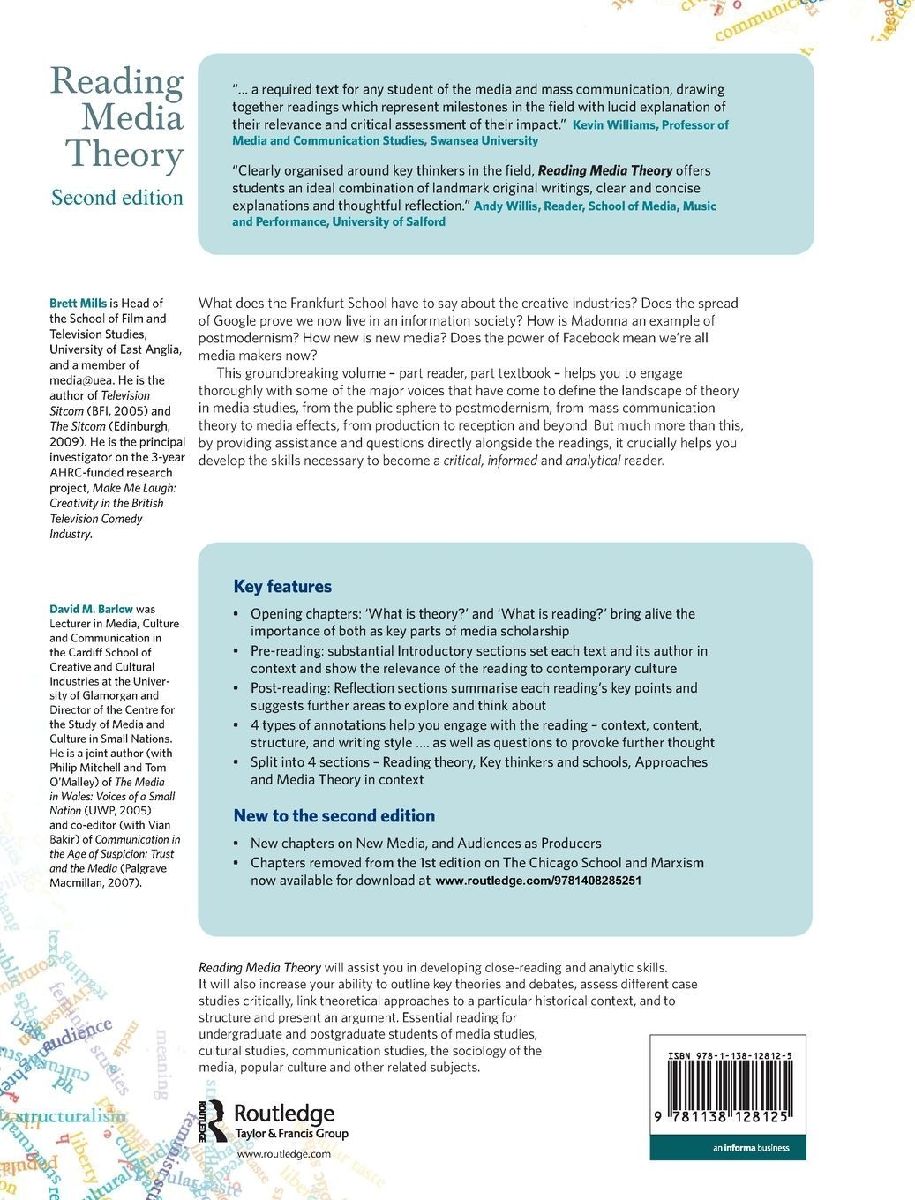
This groundbreaking volume – part reader, part textbook - helps students to engage thoroughly with some of the major voices that have come to define the landscape of theory in media studies, from the public sphere to postmodernism, from mass communication theory to media effects, from production to reception and beyond. But much more than this, by providing assistance and questions directly alongside the readings, it crucially helps students develop the skills necessary to become a critical, informed and analytical reader.
Inhaltsverzeichnis
1. Introduction Part I: Reading theory 2. What is theory? 3. What is reading? Part II: Key thinkers and schools of thought 4. Liberal press theory 5. F.R. Leavis 6. The Frankfurt school 7. Harold D. Lasswell 8. The Columbia school 9. C. Wright Mills: Mass society theory 10. The Toronto school 11. The Centre for Contemporary Cultural Studies Part III: Approaches to media theory 12. Political economy. 13. Public sphere 14. Media effects 15. Structuralism 16. Feminist media theory 17. Cultural theory 18. New Media 19. Postmodernism. 20. The information society Part IV: Media theory in context 21. Production 22. Texts 23. Audiences 24. Audiences as producers