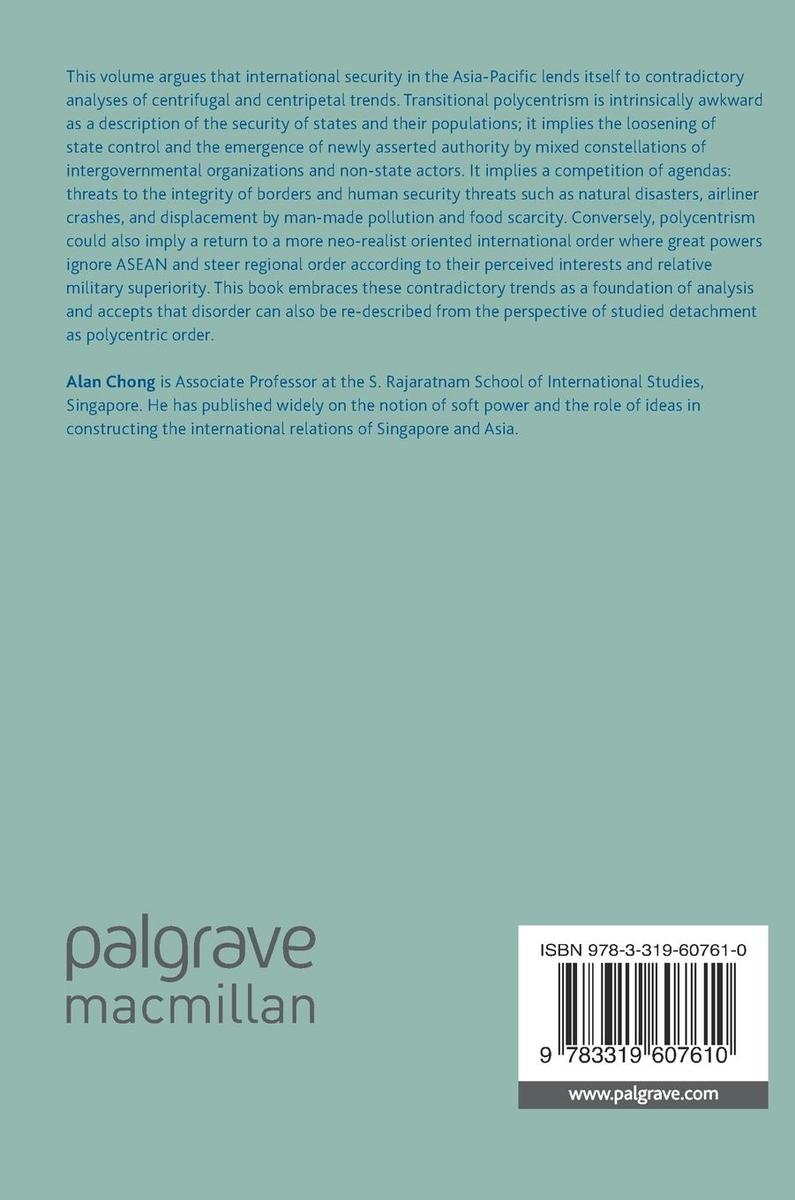
This volume argues that international security in the Asia-Pacific lends itself to contradictory analyses of centrifugal and centripetal trends. Transitional polycentrism is intrinsically awkward as a description of the security of states and their populations; it implies the loosening of state control and the emergence of newly asserted authority by mixed constellations of intergovernmental organizations and non-state actors. It implies a competition of agendas: threats to the integrity of borders and human security threats such as natural disasters, airliner crashes, and displacement by man-made pollution and food scarcity. Conversely, polycentrism could also imply a return to a more neo-realist oriented international order where great powers ignore ASEAN and steer regional order according to their perceived interests and relative military superiority. This book embraces these contradictory trends as a foundation of analysis and accepts that disorder can also be re-described fromthe perspective of studied detachment as polycentric order.
Inhaltsverzeichnis
Chapter 1: Southeast Asia : a Global Periphery No More -
Dr Ooi Kee Beng, Institute of Southeast Asian Studies, Singapore. -
Chapter 2: ASEAN Centrality in Defense and Security Cooperation in East Asia -
Professor See Seng Tan, S. Rajaratnam School of International Studies, Singapore. -
Chapter 3: ASEAN' s Limits with respect to Conflict Resolution in the Region -
Professor Kriengsak Chareonwongsak, Institute of Future Studies for Development, Thailand. -
Chapter 4: Animating Transitional Polycentrism: the Role of China -
Assistant Professor Hoo Tiang Boon, China Programme, S. Rajaratnam School of International Studies, Singapore. -
Chapter 5: The Emerging Security Landscape in the Asia-Pacific: Where ASEAN fits -
Professor Huang Xiaoming, Victoria University of Wellington, New Zealand. -
Chapter 6: ASEAN in the Era of Japan-China Tensions: Diplomatic Opportunities or Strategic Dilemmas? -
Associate Professor Takeshi Yuzawa, Hosei University, Japan. -
Chapter 7: The Role of the US Quasi-Alliances in Asia: Shadow Puppetry or Hard Alliances? -
Assistant Professor Charmaine Misalucha, De La Salle University, Philippines. -
Chapter 8: Order in South Asia and the Indian Ocean Region: Indian Hegemony or Indian Primacy? -
Dr. Manjeet S. Pardesi, Lecturer in International Relations, Victoria University of Wellington, New Zealand. -
Chapter 9: Fostering Military Diplomacy with America s Bilateral Allies: The Philippine Policy of Linking Spokes Together -
Professor Renato Cruz de Castro, De La Salle University, Philippines. -
Chapter 10: Reasons for Optimism? China, Japan and Unilateral Naval Restraint in the East China Sea -
Dr Collin Koh, Maritime Programme, S. Rajaratnam School of International Studies, Singapore. -
Chapter 11: The Asia-Pacific Diplomacy of Counter-Terrorism in Tackling the Threat from the Islamic State -
Associate Professor Bilveer Singh, Department of Political Science, National University of Singapore, Singapore. -
Chapter 12: Climate Change and Food Insecurities Destabilizers of ASEAN Centrality? -
Dr Tamara Nair, Centre for Non-Traditional Security, S. Rajaratnam School of International Studies, Singapore
. - Chapter 13: Subnational Conflict Mitigation: Networks, innovations, and the uncertain place of ASEAN -
Assistant Professor Linda Quayle, The University of Nottingham (Malaysia Campus), Malaysia. -
Chapter 14: Silos, Synergies and Prospects for Cooperation in the Asia-Pacific: Humanitarian Assistance and Disaster Relief -
Dr Alistair D. B. Cook, Centre for Non-Traditional Security, S. Rajaratnam School of International Studies, Singapore. -
Chapter 15: Asia s Military Competition by Proxy: Competitive HADR as a Respectable Arena? -
Associate Professor Alan Chong, S. Rajaratnam School of International Studies, Singapore. -
Chapter 16: Re-conceptualizing the Role of the Military for International Disaster Relief: Exploring the Factors Conditioning Responses by the Militaries of Japan, Taiwan, China, and South Korea -
Mr Jeffrey Engstrom, RAND Corporation, USA.