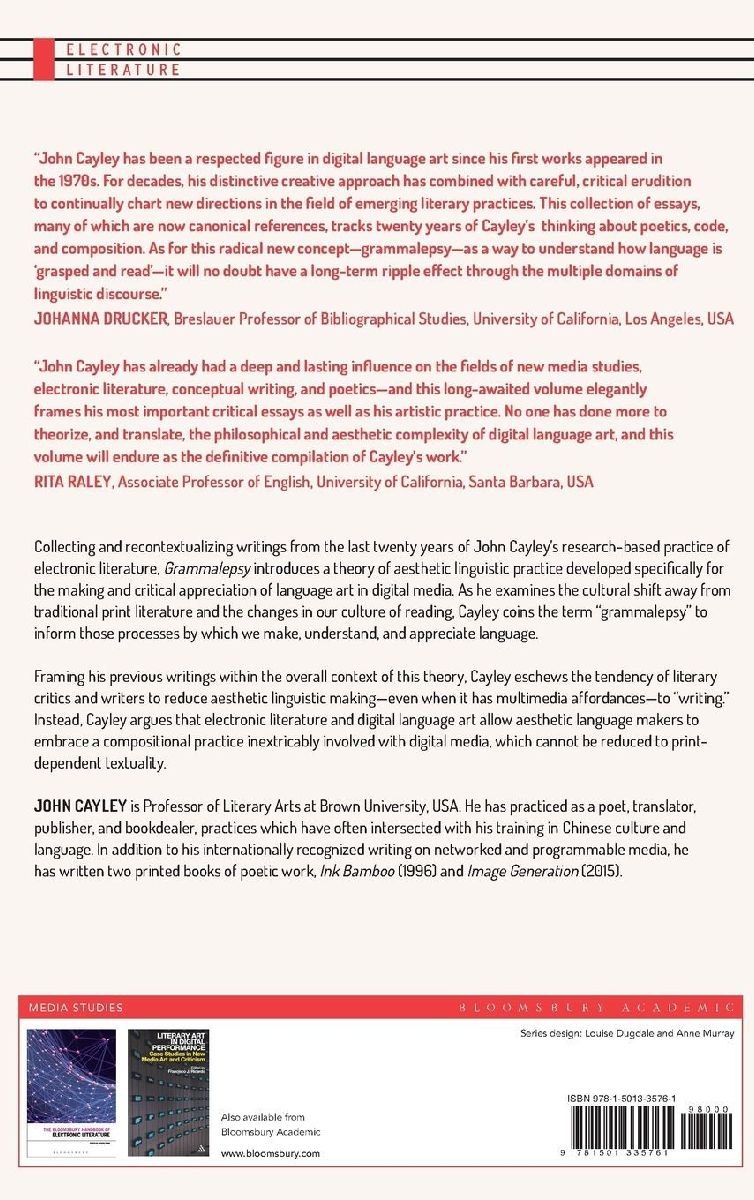
Collecting and recontextualizing writings from the last 20 years of John Cayley's research-based practice of electronic literature, Grammalepsy introduces a theory of aesthetic linguistic practice developed specifically for the making and critical appreciation of language art in digital media. As he examines the cultural shift away from traditional print literature, Cayley coins the term "grammalepsy ? to refer to the process by which this grammatization occurs. Framing his previous writings within the overall context of this theory, Cayley eschews the tendency of literary critics and writers to reduce aesthetic linguistic making-even when it has multimedia affordances-to "writing. ? Instead, Cayley argues that electronic literature and digital language allow aesthetic language makers to embrace a compositional practice inextricably involved with digital media, which cannot be reduced to print-dependent textuality. Interstitial notes between the essays will point to the nodes (URIs) of an archival network devoted to Cayley's associated practice, housed and maintained by Brown University, USA.
Inhaltsverzeichnis
List of Figures
Preface
AcknowledgementsIntroduction: Grammalepsy01. Beyond Codexspace: Potentialities of Literary Cybertext
02. Pressing the "Reveal Code" Key
03. Of Programmatology
04. The Code Is Not the Text (Unless It Is the Text)
05. Hypertext/Cybertext/Poetext
06. Writing on Complex Surfaces
07. Time Code Language
08. The Gravity of the Leaf
09. Writing to Be Found and Writing Readers
10. Weapons of the Deconstructive Masses
11. Terms of Reference & Vecotralist Transgressions
12. Reading and Giving / Voice and Language
13. Reconfiguration
14. An Instance of Aurature at the End(s) of Electronic LiteratureBibliography
Notes